

When choosing the right software for your business as an owner, you face a key question: Should we build our own solution or opt for an off-the-shelf one?
At first glance, buying off-the-shelf seems attractive: it’s ready to use, cheaper upfront, and quicker to implement. However, as companies grow, it’s essential to consider that these prepackaged tools eventually reach a limit. They can’t adapt to your unique workflows, integrate with complex systems, or support rapid innovation, ultimately limiting business growth.
Custom software companies step in to offer agile collaboration, tailoring solutions to meet the unique needs of their clients. By building solutions that address your processes, goals, and customers, they enable any business to be smarter, faster, and more innovative without limits. Let’s examine why custom solutions outperform off-the-shelf solutions and how to make the right choice.
Popular Off-the-Shelf Enterprise Software
Many companies choose off-the-shelf software, but it’s worth considering that it often comes with built-in customization limitations. Since companies don’t have access to the source code, they can’t fully adapt features or interfaces to meet their unique needs. As a result, businesses often end up adjusting their internal processes to fit the software’s capabilities, rather than having technology designed to support and enhance their existing workflows.
| Tool | Category | Best for |
| Salesforce | Customer relationship management | This shelf solution manages customer relationships, automates sales pipelines, and integrates marketing and service workflows. Typically, it’s the preferred choice for enterprises requiring a scalable, all-in-one CRM. |
| HubSpot | CRM and marketing automation | Companies use this platform to attract leads and manage inbound marketing campaigns. Best for SMBs and startups looking for cost-effective automation. |
| SAP S/4HANA | ERP and enterprise management | Helps large enterprises handle finance operations, supply chain, HR, and business operations from a centralized platform. |
| Oracle NetSuite | ERP for financial management | Scaling businesses choose this shelf solution for optimizing financial planning, e-commerce, inventory, and HR. |
| Microsoft Teams | Unified collaboration suite | Combining video conferencing, chat, file sharing, and MS Office tools. Best for enterprises using the Microsoft ecosystem. |
| Jira | Project management | Helps manage agile software projects, sprints, and releases. Preferred by software development teams needing structured workflows. |
| Asana | Project, work management | SMBs and marketing teams use the software tool to manage campaigns and organize tasks, milestones, and timelines across teams. |
| QuickBooks | Accounting and finance | Helps SMBs that seek solutions for automating invoicing, expense tracking, and payroll. |
| Tableau | Business intelligence and analytics | Enterprise software solution for visualizing and analyzing data through interactive dashboards. |
LaSoft: Custom Software Development Expertise with Ready-to-Use Solutions
At LaSoft, we develop custom software and build solutions to meet the unique needs of your business. But our dedicated team didn’t stop there; our team has also created a range of ready-to-use, off-the-shelf digital products designed to help businesses accelerate digital transformation without starting from scratch.
Unlike generic off-the-shelf platforms, our solutions are developed in-house and can be fully customized by our team to fit your industry-specific needs, business workflows, and branding. The advantages of these shelf products are apparent, as such software is already developed and tested, and implementation is faster, more cost-efficient, and less resource-intensive compared to building software from scratch. We created them with deep industry expertise and using emerging technologies.
| Solution | Category | Best for | Key features | Business impact |
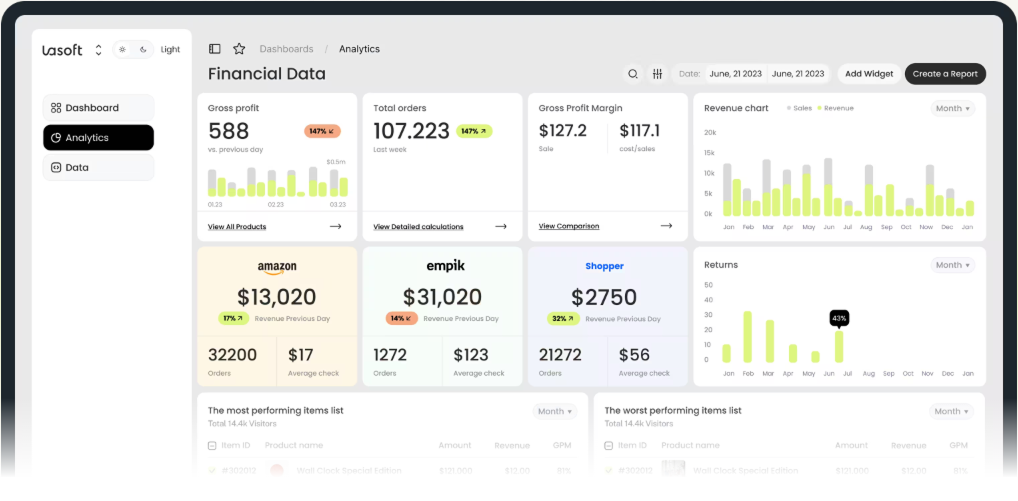
| DataPoint | Business intelligence and analytics | SMBs, Enterprises | Ready-to-use dashboard constructor with customizable widgets, seamless data visualization, and integration with ERP, CRM, and e-commerce systems. | Enables data-driven decisions, boosts operational transparency, and saves 35%+ on custom dashboard development. |
| CommUNIty | AI-Powered social network | Universities, Colleges, EdTech platforms | AI-managed digital university hub, real-time Q&A, personalized notifications, integration with e-learning platforms, and student databases. | Enhances student engagement, improves administrative efficiency, and reduces manual communication workload. |
| AI agent for logistics | AI voice assistant | Freight brokers, carriers, dispatchers | Verifies MC numbers, automates tasks and shipment tracking, negotiates rates, and integrates with TMS systems. | Reduces dispatcher call volumes by 50%, improves route efficiency, and accelerates delivery timelines. |
| AI agent for e-commerce | Conversational AI and automation | Online stores, marketplaces, and e-retail | AI-driven order status updates, returns processing, personalized recommendations, and 24/7 multilingual support. | Improves customer retention, reduces cart abandonment, and enhances overall customer experience automation. |
| Universal AI Agents | Cross-industry automation | Enterprises, SMBs, startups | Adaptable for finance, insurance, HR, procurement, healthcare, and marketing workflows. | Automates repetitive tasks, integrates across systems, and reduces manual overhead by up to 60%. |
| Healthcare AI agent | Healthcare automation and virtual assistance | Hospitals, clinics, and telemedicine providers | Validates insurance, manages appointments, explains prescriptions, supports HIPAA/GDPR compliance, and integrates with EHRs. | Reduces admin tasks by up to 70%, improves patient engagement, and ensures secure, compliant communication. |
| Healthcare responder | Conversational Healthcare Support | Clinics, pharmacies, healthcare providers | Patient triage, prescription guidance, FAQs, appointment scheduling, and real-time test updates. | Enhances patient satisfaction, reduces response times, and offers 24/7 multilingual support. |
| Industry-specific chatbots solution | AI-Powered customer support | SMBs, SaaS, enterprises | Handles FAQs, product queries, onboarding, and AI-driven recommendations across web, WhatsApp, and messenger. | Cuts support costs by 40%, drives conversions, and improves customer experience. |
| Lasoft admin panel | Solution for management | SMBs, enterprises | A ready-to-use, low-code solution designed for the fast and cost-effective implementation of complex admin systems. Built with predefined components and customizable designs, it allows businesses to add industry-specific workflows, dashboards, analytics, onboarding, and verification processes. | This innovative solution allows clients to save approximately 35%-40% on developing complex custom admin systems. |
Key Reasons Customized Software Development Outperforms Shelf Software
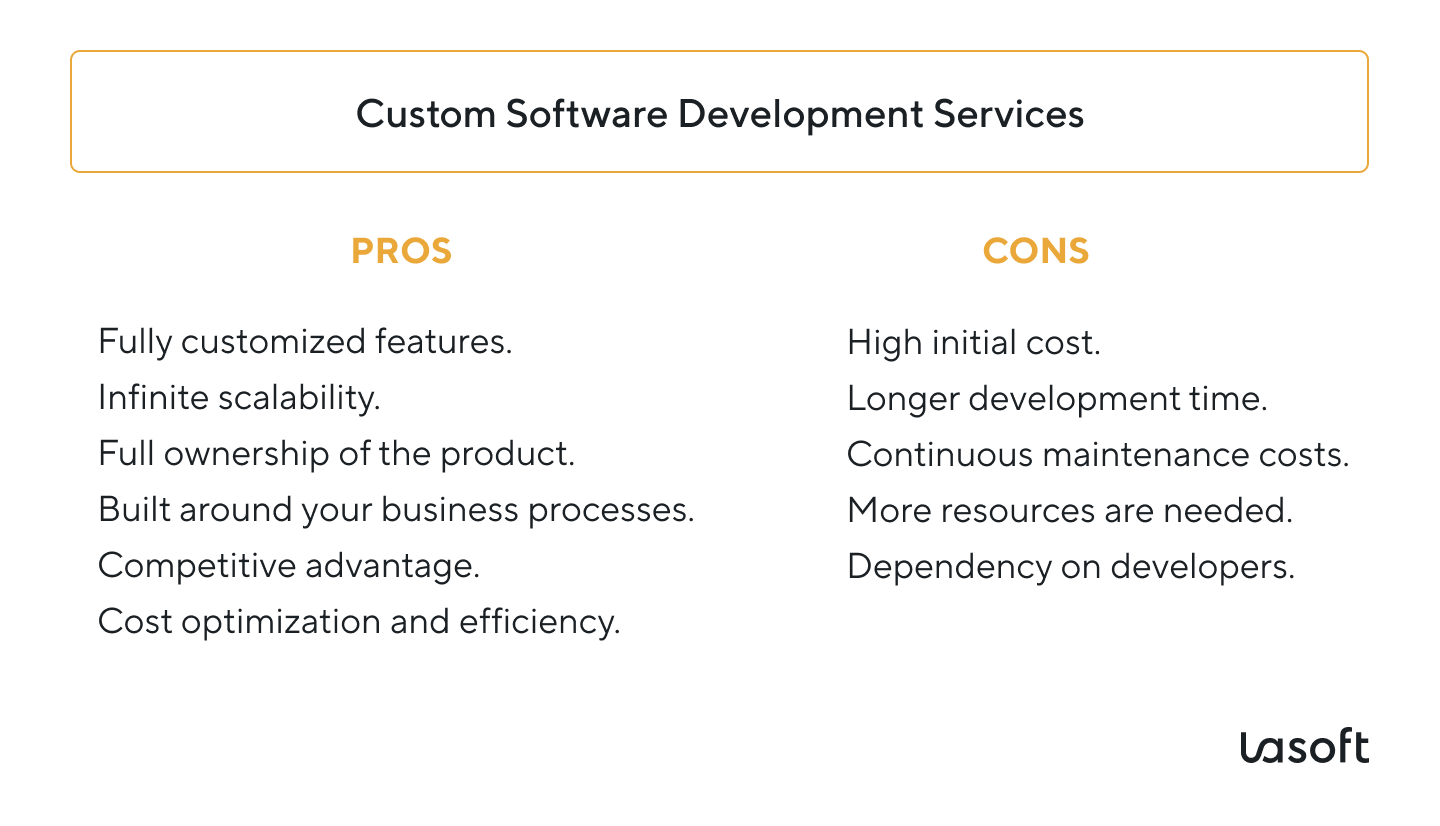
At first glance, off-the-shelf software appears to be the easiest choice; it’s quick to deploy and often comes with a lower upfront cost. However, as companies grow, these “one-size-fits-all” solutions often can’t adapt to unique workflows. While off-the-shelf tools may appear cost-effective upfront, most businesses ultimately end up paying for unused features and struggle with scalability. Custom software, on the other hand, ensures you invest in features that drive your growth, making it the smarter long-term strategy.
Tailored functionality |
Custom software development enables precise alignment with a company’s specific workflows and operational needs, eliminating unnecessary features and compromises often found in off-the-shelf options. |
Cost savings |
Companies using custom software report significant increases in operational efficiency (up to 35-40%) and reductions in process bottlenecks and customer service costs. Automation and error reduction contribute to annual savings of 20-30% compared to off-the-shelf systems. Although the upfront costs are higher, the absence of ongoing licensing fees and reduced inefficiencies leads to greater savings over 3-5 years. |
Flexibility and scalability |
Custom software adapts as the business processes grow and evolve, accommodating new features and scaling without performance issues. Off-the-shelf software often cannot keep pace with changing needs or growth plans. |
Competitive advantage |
Custom software solutions provide businesses with unique features that differentiate them from their competitors. It offers complete control over software security, updates, and modifications, enhances security (reducing cyberattack risks), and strategic alignment. |
Integration |
Custom software seamlessly integrates with existing tools and systems, ensuring smooth data flow. Off-the-shelf apps might lack necessary integration functionality. |
Customized Solutions vs Shelf Software
| Custom software solutions | Off-the-shelf software | |
| Initial investment | $50K–$400K higher upfront, but tailored to your needs | $1K–$100K lower cost to start, but may require costly add-ons |
| Definition | Tailor-made applications built to meet specific business needs. | Pre-built, ready-to-use software solutions designed for broad use cases. |
| Annual maintenance | 15–25% of initial development full control over what’s updated | 22–25% of the purchase price depends on vendor contracts |
| Time to launch | 1–9 months timeline depends on complexity and customization | Almost immediately deployable right after purchase |
| Feature utilization | 100% of features built for your needs, no “dead weight” | On average, businesses use only 10–15% of available features |
| Scalability | Designed to grow with your business and adapt seamlessly | Scaling options are limited by the vendor’s pricing and infrastructure |
| Integration | Seamless integration with your existing systems and workflows | Integration can be complex and costly, up to 40% extra |
| Security | Lower-risk, unique architecture, harder for hackers to exploit | Higher-risk, widely used software systems are common cyberattack targets |
| Customization | Full control over functionality, UX, and workflows | Limited flexibility, you adapt to the vendor, not the other way around |
| Ownership | Full ownership of the code, data, and IP | Vendor-controlled, dependent on their roadmap and policies |
| Updates and upgrades | On-demand updates based on your priorities | A vendor-driven schedule may add features you don’t need |
| ROI Timeline | Typically achieved within 2–3 years through optimized efficiency | Long-term costs can outweigh initial savings due to recurring fees |
| Business Alignment | Software adapts to your business processes | Businesses must adapt processes to fit software constraints |
| Support | Dedicated support from your dev team or partner company | Vendor support and user communities |
Types of Custom Software Solutions
Custom software solutions come in many forms, each tailored to address specific business needs, industry requirements, and strategic goals.
| Enterprise software development services | For large companies, enterprise applications manage complex operations like ERP, CRM, HRMS, and supply chain systems. |
| Customer-friendly applications | Web platforms, mobile apps, e-commerce systems, and client portals to deliver a personalized experience, boost customer engagement, and reflect your brand. |
| AI-powered solutions | AI agents, predictive analytics, chatbots, and machine learning-driven automation to optimize decision-making, customer support, and operational processes across various industries. |
| Business intelligence and data analytics tools | Custom dashboard development enables data-driven insights, transforming raw data into visual metrics, allowing leaders to track KPIs, identify opportunities, and make informed decisions more quickly. |
| Industry specific systems | Let’s take as an example telemedicine solutions, learning management platforms, HR tech tools or logistics optimization software, custom software development companies build solutions that fit your specific industry. |
Cloud-based custom software |
Cloud development involves creating customized software solutions that are deployed on the cloud. Businesses seek solutions that leverage cloud computing and incorporate advanced technologies, such as machine learning and computer vision. |
The Essential Advantages of Custom Software Development Services
When your business starts to grow, your software’s true capabilities are put to the test. While off-the-shelf tools may meet today’s needs, they often fail to evolve alongside your operations. Custom software projects, on the other hand, are designed to adapt, scale, and integrate.
Scalability
As companies grow, software limitations often become a hidden bottleneck. Shelf solutions typically manage scaling through pricing models or expensive add-ons, forcing businesses to pay more as they grow while still hitting technical constraints. Yes, upfront investment requires less budget than custom software development, but in the end, you spend more when you start scaling.
Custom-built solutions take a fundamentally different approach. Scalability enables your system to grow organically alongside your operations. With custom software, you can:
- Support higher data volumes and user loads without performance drops;
- Expand functionality modularly without replacing your entire system;
- Handle complex transactions and workflows as your operations evolve;
- Scale resources dynamically based on real-time demand;
- No costly downtime or system failures.
Flexibility
Every company has its own unique workflows, priorities, and customer demands. Off-the-shelf software locks you into predefined templates and rigid features, often forcing you to adapt your processes to fit the tool.
Custom solutions adapt to your processes, helping you build competitive advantages that off-the-shelf systems can’t replicate. Flexibility offers:
- Complete control over features, interface, and user experience;
- Customized workflows aligned with your existing business processes;
- Fast modifications to support new regulations, markets, or strategies;
- Industry-specific functionality unavailable in generic products;
- Continuous evolution to meet changing business needs.
Integration
Custom software development helps avoid data silos, inefficiencies, and costly workarounds. Off-the-shelf platforms often require manual reconciliation or expensive middleware, which can increase implementation costs by up to 40%.
Custom development solves this by designing integration into the architecture from the start. That means your software can:
- Unify data across systems for a single source of truth;
- Automate workflows between applications without manual input;
- Deliver consistent user experiences across all platforms;
- Eliminate duplicate processes and redundant data entry;
- Leverage real-time insights by connecting analytics, ERP, CRM, and BI tools.
Customization
Generic tools are designed for broad audiences, usually meaning limited personalization and no access to source code. Businesses often end up modifying their processes simply to make the software function properly.
Custom-built software flips this dynamic and provides unrestricted customization, allowing your technology to become a strategic asset.
- Build integrated apps tailored to your business’s exact requirements;
- Modify or upgrade features anytime without vendor dependency;
- Create unique competitive advantages through differentiated capabilities;
- Implement niche, industry-specific features unavailable in packaged solutions.
Final Insights
When a business owner chooses between building a custom application and shelf solutions, it comes down to long-term value versus short-term convenience. Pre-built tools attract businesses with their lower upfront costs and quick deployment; they often fall short when businesses need scalability, deep customization, and seamless integration.
Custom software development services offer to invest in future-proofing your business by aligning technology with your unique workflows, strategic goals, and growth plans. LaSoft, as a custom software development company, combines over 10 years of expertise in custom software development with a portfolio of ready-to-use, customizable products, delivering solutions that meet your unique business requirements.
FAQ
Why choose custom software companies over shelf solutions?
Are custom software solutions worth the higher upfront investment?
How does LaSoft ensure seamless integration with my existing systems?
What industries does LaSoft specialize in?
What is custom software development services?
- Custom software development is the process of designing, creating, and deploying software applications to meet specific business requirements.
- A custom software development company can help develop custom solutions that improve the efficiency of your business operations.
- Custom software development services involve creating software tailored to a specific business or industry.
- This approach enables businesses to develop custom software tailored to their specific challenges and requirements.
What are the benefits of a custom software development project?
- Custom software provides a competitive advantage by meeting specific business needs.
- It improves business processes by automating tasks and business workflows.
- Building custom software can help businesses gain a competitive edge by providing innovative solutions.
- It also enables businesses to monitor system performance and make data-driven decisions with the aid of advanced technologies, such as machine learning and natural language processing.
Is custom software development worth the higher cost?
While upfront investment is higher, businesses using custom software achieve ROI within 2–3 years thanks to:
- No recurring licensing fees
- 20–40% annual savings via automation
- Optimized workflows and fewer manual processes
- Better scalability without costly add-ons
Can LaSoft customize its off-the-shelf products?
How does LaSoft ensure smooth integration with existing systems?
How do custom solutions support business scalability?
Custom software is designed with scalability at its core:
- Handles growing data volumes and user loads;
- Expands features modularly without replacing systems;
- Adapts quickly to new markets, regulations, or strategies;
- Avoids costly downtime or performance bottlenecks.
Why do businesses outgrow off-the-shelf apps?
Businesses outgrow these apps as most packaged tools:
- Offer generic workflows that don’t match evolving business models
- Require expensive add-ons to scale
- Limit customization and integration capabilities
- Result in paying for unused features (up to 80% remain untouched on average)
What types of custom software solutions does LaSoft offer?
We develop end-to-end custom solutions tailored to your business:
- Enterprise applications: ERP, CRM, HRMS, supply chain;
- AI-powered tools: voice agents, chatbots, predictive analytics;
- Business intelligence dashboards: custom dashboard development and DataPoint solution;
- Workflow automation platforms: for logistics, healthcare, procurement, marketing, real estate, education, finance, and insurance.