

Project discovery is a crucial first stage in software development, both for startups and enterprise projects. This stage helps startups understand the problems to solve, outlines the project’s goals, and creates a roadmap for successfully launching a digital product to the market.
For enterprise digital transformation projects, it helps to identify the main stakeholders, identify their pain points and requirements, and plan the optimal strategy for the company’s digitalization.
Key Takeaways:
- A Project Discovery Stage is crucial for any Software Project’s Success. Project managers should allocate 10%-15% of the entire project time and budget specifically for the project discovery stage.
- Companies can consider on-site Project Discovery for nearshore development, inviting the dev team to their facility. This will help identify user needs in the users’ environment and ensure productive cooperation during development.
- Learn more about modern tools and techniques during the discovery stage and what is there for your team.
- Core deliverables of cooperation with LaSoft on-site project discovery team.
What Is the Product Discovery Stage by LaSoft?
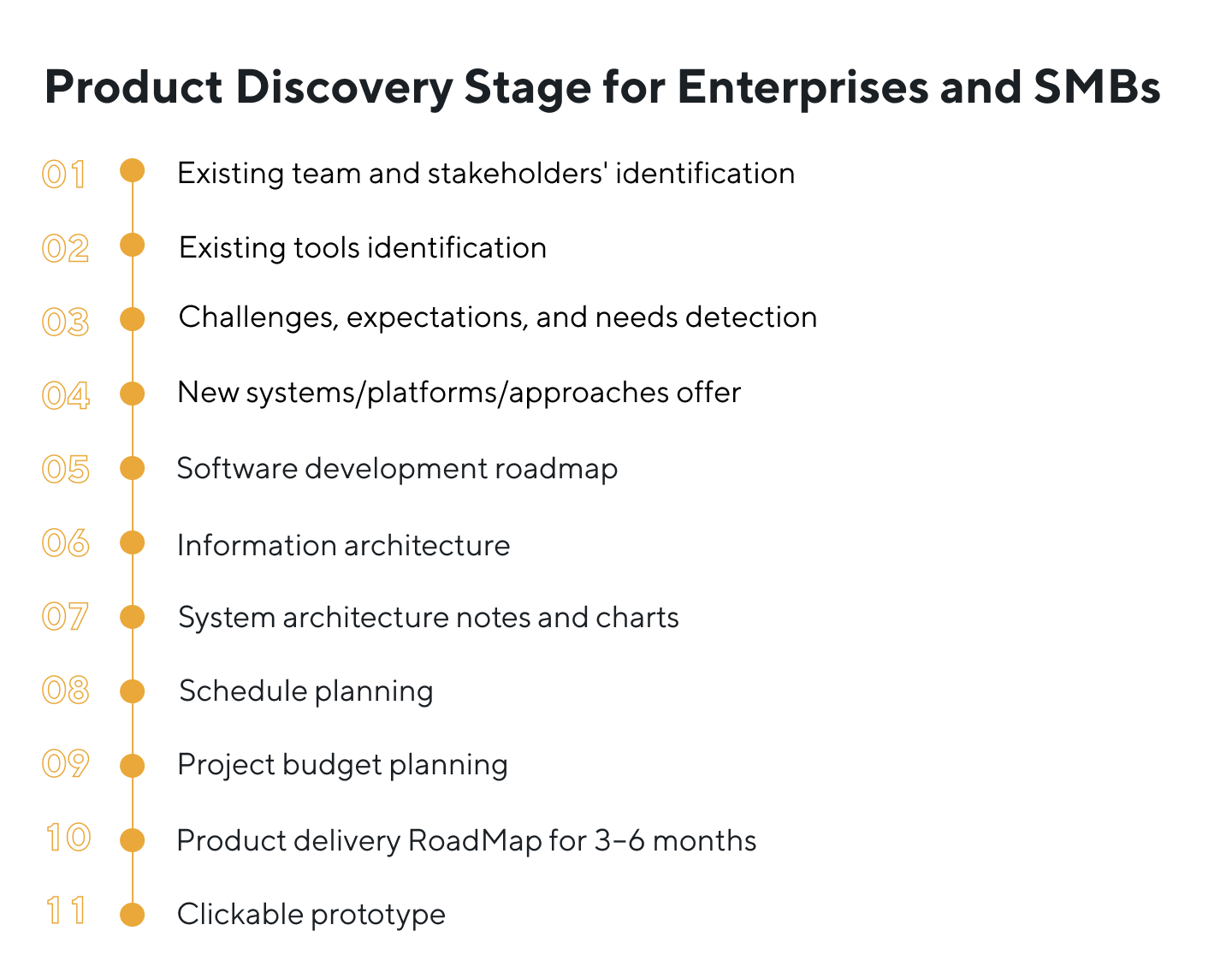
Professional project discovery is the initial step, which helps to guide the whole software development process. We can reduce risks and avoid expensive corrections later by spending time and effort at the start. This way, we can create a software development product that exceeds expectations. Usually, the project discovery phase primarily includes
- an existing team and stakeholders identification,
- challenges, expectations, and needs detection,
- new systems/platforms/approaches offering,
- software development roadmap to define core features,
- system architecture, project estimation,
- UX design for custom solutions we can offer to make your digital transformation a success.
Let’s find out what discovery is in general and what benefits your business can get if you invite an on-site software project discovery. Last but not least, why should you check your options with the LaSoft team?
| Tool/Technique | Description |
| Existing Team/ Stakeholders Identification | Collaboration with stakeholders and the in-house team helps understand who will impact or be impacted by the project. We categorize and manage each stakeholder’s level of influence, interest, and communication needs throughout the project lifecycle. Tools like flowcharting software (Miro/Flowmap) help visualize workflows, making it easier to spot inefficiencies and potential for automation or optimization. |
| Existing Tools Discovery | The LaSoft team does due diligence on the client’s current tech stack to evaluate its performance and compatibility with the new solutions. This includes assessing software, databases, APIs, and infrastructure to determine which elements can be retained, modified, or replaced. We can use documentation tools like Google Docs, Confluence, or Notion to record these findings. |
| Challenges/Expectations/Needs : | We define challenges, expectations, and needs using one or several techniques:
– Client interview. This technique helps to gain important insights about the product, how it should work, problems to solve, how to use it, and what needs to be covered. We can conduct several interviews to gather as much information as possible. – Value Proposition Canvas. It is useful to conduct such workshops with a client to define needs and expectations and find out how we can meet them. – SWOT analysis. This technique can help define the strengths and weaknesses of the product we want to produce. |
| New systems/platforms/technologies offer | Based on research, LaSoft advises on the enterprise’s most suitable technology stack and tools. This involves evaluating programming languages, frameworks, libraries, and cloud services that align with the project goals, workloads, and requirements. We offer software tools you can find on the market; they will save you money and time. Our experts also advise if your company needs custom software solutions. |
| Project Budget Planning | Project budget planning involves creating a comprehensive financial estimate for the project. This budget planning involves estimating the costs associated with purchasing existing tools on the market or developing core features of the custom development product, considering the complexity, resources required, and time needed to complete each feature. This includes estimating design, prototyping, development, testing, and development hours.
We also determine the composition of the required team (developers, designers, project managers, and QA testers) and calculate their rates. We consider whether the resources are full-time, part-time, or ad hoc depending on the need for specific tasks. The estimate also includes the cost of third-party tools, software licenses, hosting, and infrastructure required for the project: cloud services, APIs, and any software solutions recommended for integration.
|
| Clickable Prototype/MVP | Depending on the project scope, LaSoft will deliver a clickable prototype or a minimal viable product (MVP) that stakeholders can test to validate key functionalities and user interactions. This option allows stakeholders to understand the look and feel of the product before the development process starts. |
| Software Development Roadmap | This roadmap defines core features for custom solutions and establishes a timeline for the project’s development stages. |
Advanced Tools and Techniques We Use in Product Discovery
The discovery stage is a critical phase in product development. During this phase, the team identifies user needs, market conditions, and potential opportunities. Below is an elaborated version of the table that highlights key tools and techniques used during this initial stage and describes them.
| Tool/Technique | Description |
| Value Proposition Canvas | It helps to define the key users (their needs, pains, benefits, and the way they need to use the system) and confirm that the product will meet the users’ expectations and needs and bring value to the user. |
| WBS | It shows roles and all available functions for a specific role. The work breakdown structure shows the roles and modules into which the project is divided, as well as the subpages that a user can check/use. |
| User/System Flow | The team can quickly grasp and evaluate the strengths and weaknesses of the product solution based on the finished user flow because it helps to understand whether each process the user goes through has a logical conclusion. It helps define and improve existing and/or future problems. |
| BPMN | It is a method that helps visualize a business process’s end-to-end operations. Business process modeling represents the company’s processes graphically using standardized notations. It helps to create an overview of all the steps required to carry out a business process and to avoid miscommunication between teams and stakeholders. |
| LaEstimator | It’s one of the LaSoft tools we use to create a product roadmap and assess the expected timeline and budget. We already have 500+ projects and 2200+ modules in our database, which allows us to make the estimation 18 times faster than the competition.
We often conduct workshops for clients to ensure that core features are in order and to provide the most efficient development release. This means a successful product launch within the defined time frame and budget expectation. |
What Is the On-site Software Project Discovery Phase?
During the on-site project discovery stage, experts join your team right at your location and dive into your workflows and market environment to see your processes, challenges, and goals up close. This hands-on way of working allows for quick feedback, ensures everyone is on the same page, and helps guide the project.
Compared to standard online communication, on-site project discovery enables a more dynamic exchange of ideas and faster problem-solving involving the client company’s managers, stakeholders, or experts.
Meeting clients or stakeholders in person fosters a sense of trust, an adequate understanding of the discovery team’s professional level, and rapport, which is challenging to replicate online. Face-to-face interaction often feels more genuine, helping to build stronger, long-lasting professional relationships. It also shows stakeholders how the discovery team invests in the project, which can improve engagement and support throughout the discovery.
The on-site approach offers the discovery team direct exposure to the environment in which the software will be used. Observing users in their natural settings can reveal valuable insights into their daily workflows, challenges, and habits that may not come up in virtual meetups.
Building relationships through face-to-face meetings encourages stakeholders to stay involved and proactive. On-site participants are generally more attentive and interactive in an in-person setting, which can lead to more productive discussions and meaningful contributions from all involved.
Who is Usually Involved in the On-site Project Discovery?
Business Analyst and System Designer are usually involved in on-site discovery. Sometimes, we also involve system architects in heavy technical projects. Often, the entire discovery may take 3-4 weeks in total. However, 1 week onside visit is usually enough to cover the main objectives of the on-site visit.
Understanding the Product Discovery Team
An on-site projects discovery team consists of professionals, each playing a specific role in the software development process and following agile methodologies. Every team member, business analyst, system architect, and product designer invests unique expertise in shaping the product according to business objectives and user needs.

On-site Project Discovery Team Example by LaSoft
Business Analyst |
A Business Analyst is crucial in evaluating business goals and project vision and exploring technological solutions through software project scope. They define key stakeholders’ requirements and make them clear for the development team in the appropriate tech language. They work closely with stakeholders to identify and define the business’s needs, challenges, objectives, and desired software functions. |
Product Designer |
The designer creates detailed wireframes and prototypes or MVP that visually represent the product’s user experience (UX). These elements give an idea of how the product will look and function, allowing them to visualize the possible final result.
The designer’s proactive approach helps identify and address potential issues before full-scale development begins, minimizing costs and aligning the project with user needs. |
System Architect |
This expert designs and develops the overarching architecture, making sure your system can cover all tech requirements and is still flexible enough to allow for possible changes. Their role involves defining the architecture interfaces, integrations, and interactions to ensure scalability, reliability, and efficiency. System Architects consider various factors such as hardware, software, network requirements, security, data management, system constraints, and creating a high-level architecture for the solution. They collaborate closely with BA and other technical stakeholders to implement and align the architecture with the business’s goals and objectives. Having an experienced business analyst is enough if the project is rather simple. |
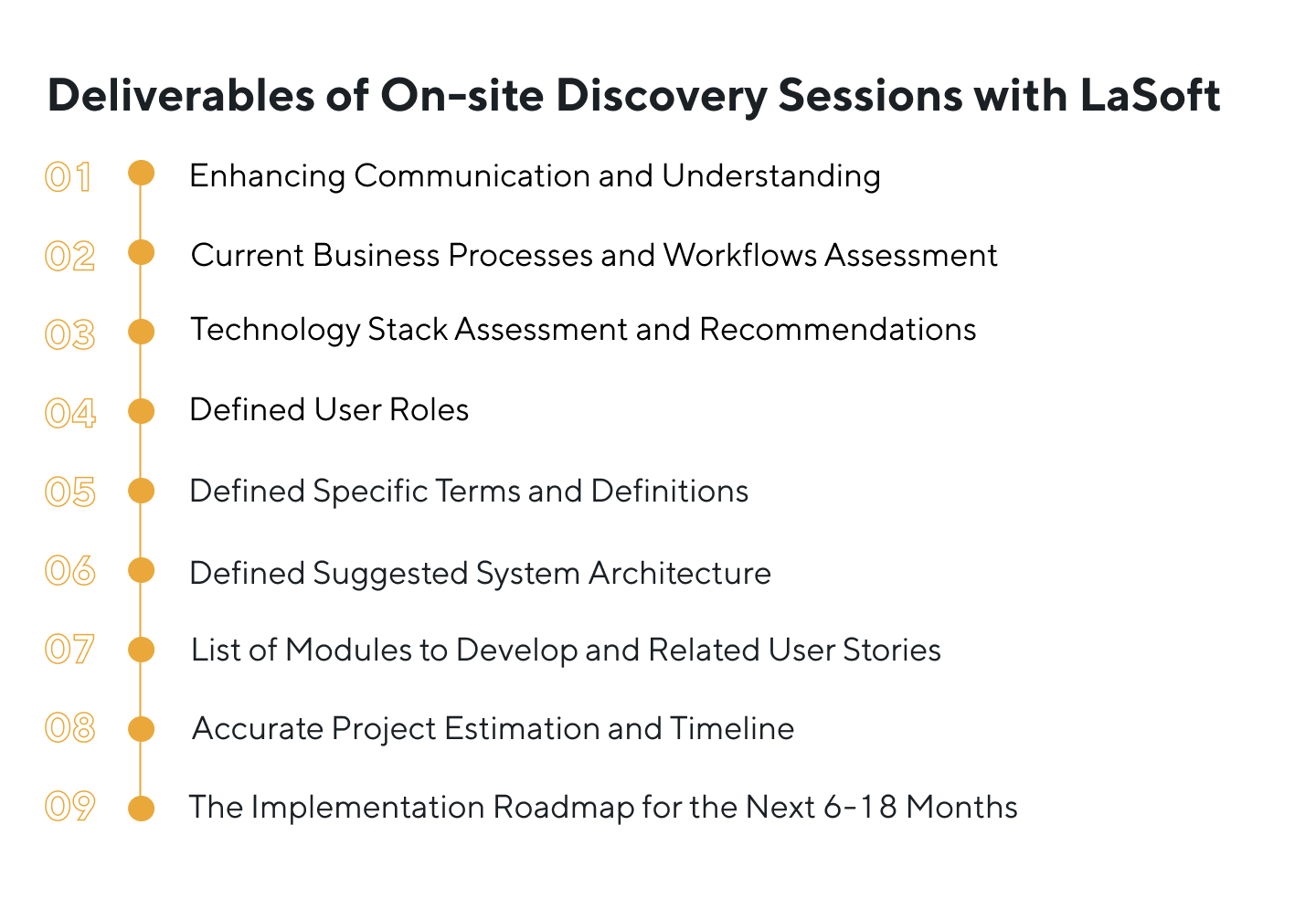
Deliverables of On-site Discovery Sessions with LaSoft
The benefits of the on-site project discovery phase go beyond building solid partnerships and improving communication. When you have open discussions and understand each other, you can lower the risks of following the wrong direction and wasting your time on eliminating issues, making the best use of your resources, and setting clear goals from the start. This teamwork helps us have easier development cycles, quicker results, and a final product that exceeds your expectations. Basically, after the discovery stage, you get the answer to all of your potential technical and business-related questions.
Enhancing Communication and Understanding
Face-to-face meetings between stakeholders, in-house, and the project discovery team help close communication gaps and build a common understanding of the project goals. On-site sessions are more than just formal talks and document checkups. They enable open discussions, brainstorming, and real-time questions and answers. The shared understanding also makes everyone feel responsible and part of the team, creating a collaborative and productive atmosphere.
Current Business Processes and Workflows Assessment
We prepare a detailed overview of current business processes and workflows, identifying potential areas for efficiency improvements and digital transformation.
We also report on the client’s current tools and technologies, highlighting areas we can improve or replace.
Technology Stack Assessment and Recommendations
We assess the client’s existing technology stack and offer expert opinions on which software solutions we can source from the market. We also recommend specific customized solutions that improve workflows, meet stakeholder requirements, and overcome market challenges. Our approach to offering a new tech stack for a client company allows our clients to save on custom development by using ready-made solutions from the software market.
Defined User Roles
We help you understand who will interact with your system. Defined user roles help you clearly understand user expectations while interacting with the product. Our experts identify all potential user roles to ensure your solution covers their needs and workflows.
Defined Specific Terms and Definitions
To avoid ambiguity, LaSoft establishes a glossary of specific terms and definitions related to your project. This effort ensures all stakeholders—technical teams, managers, and end-users—understand the project’s language.
Defined Suggested System Architecture
We provide a well-defined system architecture with a clear visualization of system components and their interaction, offering innovative technologies and frameworks. Our System Architect proposes a system architecture tailored to your business needs to ensure your software project succeeds in the market and ensures scalability, performance, and security.
List of Modules to Develop and Related User Stories
LaSoft divides your project into manageable modules and develops user stories that describe how users interact with each part of the system. We advocate a user-centric approach, ensuring your solution meets the actual needs of your target audience.
Accurate Project Estimation and Timeline
Estimating a project’s time and cost is an essential part of the project discovery process. Our team developed LaEstimator, an accurate estimating tool, to help you plan resources and budgets effectively. Our tool gives you an idea of transparent project costs with realistic timelines for delivering the final product. This information helps with the allocation and management of financial resources.
The Implementation Roadmap for the Next 6-18 Months
A clear roadmap outlines every stage of the project from start to finish. LaSoft creates an actionable timeline that maps out the development, testing, and deployment sprints for the next 6-18 months. Our roadmap also presents structured project goals and predictable milestones for tracking progress.
Aligning Business Objectives with LaSoft Technical Solutions
One main goal of LaSoft’s project discovery process is to ensure that your business goals match the technical solutions we create. Our skilled Discovery Team knows how to turn your validated ideas into accurate and effective products.
We think software development is more than technical work. It’s about using the proper technology as a key tool to grow your business, improve efficiency, and achieve real results. When we understand the reasons behind your project, we can design and create solutions that fulfill your needs and fit your strategy.
In our team-based discovery process, we connect business leaders and technical experts, helping every technical choice reflect your business needs. This approach to choosing the right technologies and tools ensures that the finished product becomes commercially successful in the market and provides a good return on investment.
The Role of Stakeholders in the Business Digital Transformation Discovery Phase
Stakeholders play a key role in any software project. Their ideas, responses, and involvement are important at every stage of the development process, starting with the discovery phase.
At LaSoft, we focus on engaging stakeholders. We make sure their opinions matter and that their viewpoints are part of the project. We think that by creating a team environment where everyone feels important and encouraged to share, we can work together to create a solution that truly serves the needs of everyone involved. We use the following tools and workshops to cooperate with stakeholders efficiently:
- Stakeholders organized interviews.
- IT Ecosystem design workshop.
- Feature and requirements prioritization workshop.
- System high-level structure design workshop.
- Prototype demo meeting.
- Release planning workshop.
- Release cost estimation and resource planning workshop.
During all those engagements, your company’s stakeholders will gain key insights into the system, architecture, design, prototyping, prioritization, resource planning, and estimation techniques. The learning value is incredible.
Bringing the right people into the discovery process is important. Finding key stakeholders is having brainstorming sessions with those who have valuable insights, can influence decisions, and understand business needs and issues well.
This might include people from different departments, including IT professionals, marketing, sales, customer support, and even end-users. By welcoming a variety of viewpoints, we can cover all sides of the project, including user experience and user interface design, how it works, and how it fits into the business.
Our team will work closely with you to identify these key people and ensure their schedules align with the discovery sessions. This careful choice is essential to maximizing stakeholder input. It helps gather detailed insights and builds a strong foundation for the project’s success. The main goal is to create a product that meets the needs of everyone involved.
Final Insights
Choosing LaSoft for your on-site software project discovery offers many advantages, like a deeper, more collaborative understanding of your business needs and challenges, an atmosphere of trust, and a reliable attitude toward the software idea we discover. Our 10+ years of experience is a foundation for our skillset to help you elevate your idea to the next level. Our team is dedicated to providing solutions that align with your objectives, reduce risks, and ultimately result in a product that exceeds expectations. We design technically sound, market-relevant, and user-focused software solutions through the on-site project discovery process. It’s always a valuable advantage that our dedicated team can support during the product development lifecycle, offering all the high-quality software development processes.
FAQ
What are the Differences Between On-Site and Remote Discovery Sessions in the Software Development Process?
Level of Interaction
| On-Site: Face-to-face interaction allows for more dynamic conversations, better understanding through body language, and immediate clarification of ideas. This option often leads to deeper brainstorming and deeper discussions. | Remote: Conferencing tools mediate interaction between the client and experts, which can sometimes limit natural conversation flow. While digital collaboration tools help bridge the gap, they may not capture the full depth of in-person communication. |
Building Relationships
| On-Site: Personal meetings build trust between clients and development teams. You’ll see in-person team members’ expertise in your environment. | Remote: Building relationships remotely can take longer, as digital meetings tend to be more task-focused. However, the right approach can still make meaningful connections over time. |
How Long Should a Discovery Phase Take?
The duration of the on-site discovery phase varies depending on the project’s complexity and scope. For small projects, it may take 1-2 weeks. For larger, more complex projects, especially those involving extensive research, technical assessments, or numerous stakeholders, it may take 2-4 weeks.