

We believe AI tools are a must-have for any company in any field; yet, you may be surprised to learn that most companies have not yet integrated them into their workflows and processes to reduce operational costs and improve efficiency.
Let’s explore if this is really worth trying innovations and automating business tasks and workflows, and what the benefits of using AI technology are for future outcomes in dynamic environments.
AI Technology Adoption and Efficiency: Statistics
-
- Approximately 88% of respondents indicate that their organization is utilizing AI in at least one business function.
- More than 60% are experimenting with AI agents (systems that can plan and act).
- Thus, companies recognize that AI and automation aren’t speculative; they’re already part of their operations.
- Around 80% of companies define efficiency as a key objective of their AI-based transformations.
- Automating workflows enables firms to innovate more quickly (e.g., introducing new products, services, or business models).
Source: McKinsey
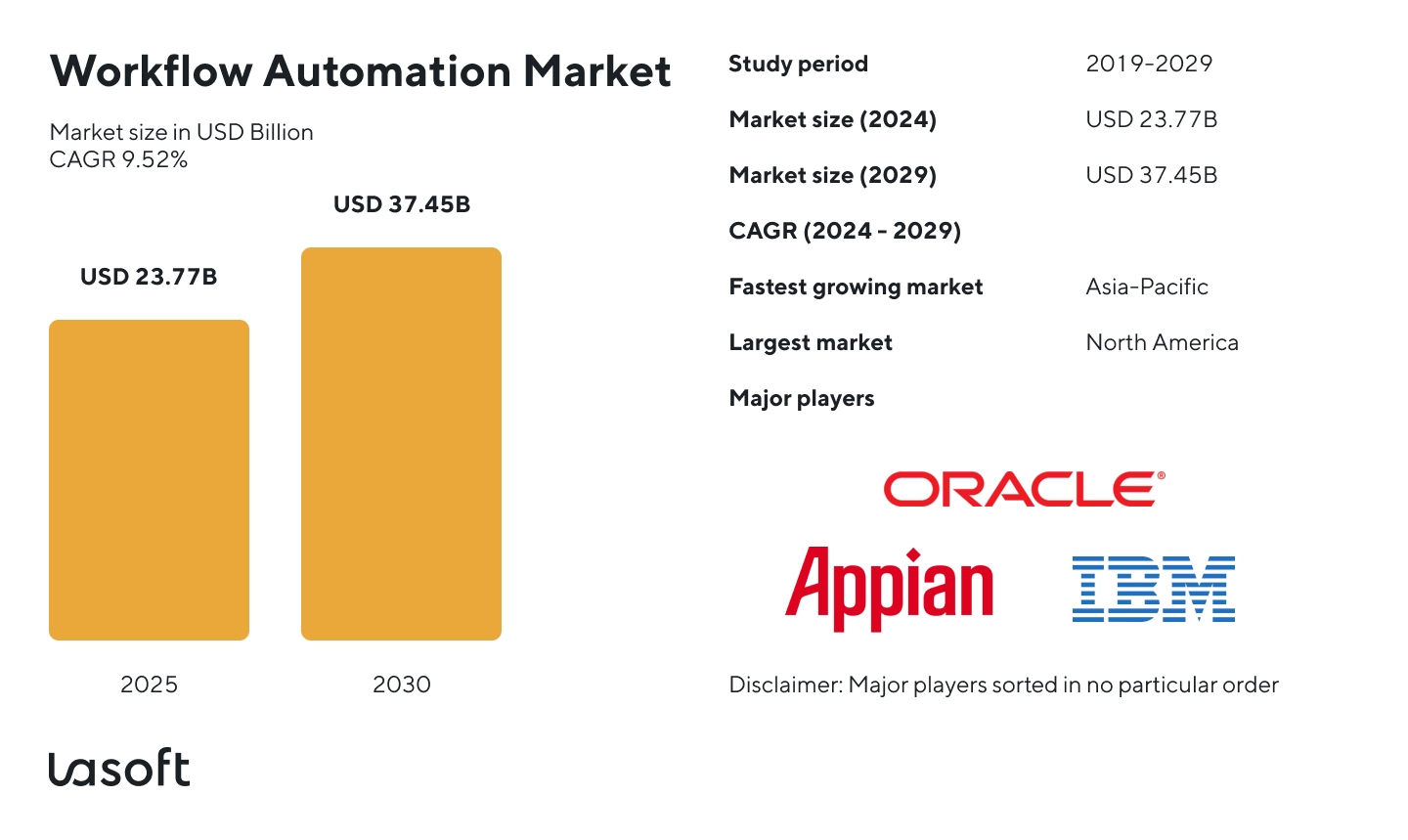
Source: mordorintelligence
The Core Benefits of Workflow Automation and AI
Businesses use artificial intelligence to automate processes and streamline operations. Let’s examine the key benefits of AI-driven workflow automation for companies based on LaSoft’s project experience.
1. Saving Time and Money
Automated workflows replace manual data entry, report generation, and approval processes. AI has adaptive logic, which enables it to identify patterns and make decisions independently.
For example, in LaSoft’s project for a logistics company, our AI-powered voice assistant automates logistics tasks by verifying MC (Motor Carrier) numbers, checking cargo status, and reducing the call pressure on dispatchers.

2. Smarter Decision-Making
AI systems take significantly less time to interpret large volumes of business data. Embedded analytics functionality drives decision-making.
Example: Our DataPoint dashboard solution helps e-commerce and retail clients visualize sales, marketing, and operational KPIs in real time, gross vs. net revenue, campaign ROI, inventory health (stockouts, turnover, returns), product performance, customer behavior, and predictive analytics (forecasting, risk of stockouts, etc.).
3. Enhanced Interaction
Intelligent automation, powered by AI, offers personalized and human-like interactions with clients. Or it helps HR teams handle inquiries and onboard new employees.
Example: An AI agent developed by Lasoft for human resources teams automates time-consuming HR operations, including resume screening, onboarding workflows, employee data updates, and FAQ responses. It also uses predictive analytics to identify employees at risk of resignation with up to five times higher accuracy than human judgment. The system identifies hidden trends in workforce behavior, enabling HR leaders to take proactive measures to enhance employee retention.
4. When Your Business Scales
AI for operational efficiency enables your business to scale intelligently. They adapt to real-time data and evolving business conditions without requiring extensive reprogramming. Automotive processes guided by AI let companies handle growth surges or seasonal demand automatically.
Example: In healthcare, an AI agent by Lasoft handles time-consuming tasks and patient triage, handling multiple queries daily. Automated systems of routine administrative workflows allow healthcare professionals to dedicate more time to patient care. As an example, an AI agent developed by Lasoft’s team can:
- Verify insurance eligibility without human help.
- Schedule, reschedule, or cancel appointments automatically, eliminating the need for manual data entry.
- Send reminders and follow-up messages to minimize patient no-shows.
- Respond via chatbot to common questions about symptoms, medication use, or post-visit instructions, always under human professional supervision.

Types of AI Used for Business Operations Automation
While traditional automation tools follow predefined rules, for example, transferring data from System A to System B, AI solutions process large amounts of information, interpret it, and adapt workflows accordingly. In practice, AI operates as an intelligent ecosystem that helps with business process management, provided that experts continually refine and retrain its models. Let’s explain the types of AI systems that drive automation technologies in business operations.
Machine Learning
Machine learning (ML) algorithms identify patterns in data and automate tasks that require regular attention without human intervention.
Machine learning can predict sales trends, optimize inventory levels, and predict when customers are likely to leave. This information guides the targeted campaigns to ensure their effectiveness and retention.
Natural Language Processing (NLP)
NLP enables machines to understand, interpret, and generate human language, navigating communication between people and automated systems. AI chatbots and virtual assistants utilize NLP to handle routine questions and streamline onboarding processes. It also analyzes customer feedback and sentiment in messages and reviews, giving companies valuable insights into how clients interact with their products.
Optical Character Recognition (OCR)
OCR technology enables the reading and conversion of printed, handwritten, or scanned text into digital documents that machines can understand. The system converts paper documents, such as invoices, contracts, receipts, and forms, into digital files, eliminating the need for manual data entry. It automatically extracts, verifies, and sorts information with high accuracy when combined with AI.
Computer Vision
Business operations automation uses computer vision to monitor equipment and ensure product quality. Computer vision identifies problems on production lines and automates warehouses by scanning barcodes and tracking inventory.
Robotics Process Automation and Intelligent Process Automation (IPA)
Traditional automation follows fixed scripts, but IPA learns from what people do to offer flexible work based on changing conditions. IPA automates repetitive digital tasks, such as order processing and database updates, as well as physical tasks, including product assembly and packaging. AI-powered robots make decisions based on real-time data to act proactively and reduce downtime.
Speech Recognition
Machines process human speech, converting spoken language into structured, readable data. Voice assistants, automated call centers, and voice-to-text systems used for data entry and transcription utilize speech recognition to change how clients’ inquiries are processed. Employees can now work hands-free with equipment, transcribe meeting notes, or retrieve information through voice commands.
Predictive Analytics
Statistical models and ML help analyze past and present data, allowing us to make educated guesses about what might happen next. They determine how customers behave, identify emerging market trends, and send alerts when it’s time for maintenance. By using predictive analytics, businesses can avoid being caught off guard by unexpected setbacks, plan more accurately, and ultimately achieve a higher return on their investment.
Expert Systems
Expert systems use rule-based reasoning to mimic human knowledge and resolve specific business problems. They are designed to generate answers, explain their reasoning, and assist with complex tasks without expert input. All in all, expert systems can diagnose problems, verify compliance, and provide strategic recommendations.
Key Business Areas to Drive ROI
Automation and AI are transforming entire corporate ecosystems. These technologies provide a clear return on investment while streamlining workflows and handling large volumes of data. AI-powered automation offers both financial and operational advantages.
| Operational Efficiency and Supply Chains | AI automates routine tasks, such as data entry, report creation, and logistics coordination, to boost operational efficiency and generate a return on investment. For example, predictive models alert you when equipment needs maintenance or identify potential supply chain issues before they occur, saving your workflows from disruption. |
| Sales and Marketing | Predictive analytics and natural language models enable the segmentation of customers, demand forecasting, and the targeting of personalized campaigns.
AI-powered marketing automation tools score leads and recommend strategies to retain existing clients and find new ones. |
| Human Resources | HR assistants automate routine hiring and onboarding processes to eliminate manual workloads, allowing HR professionals to focus on what matters most: people.
AI models, which are more accurate than human intuition, predict employee turnover, identify resignation risks, and provide actionable insights that help HR teams make data-driven retention decisions. Additionally, AI agents maintain smooth HR operations by sending automated alerts, reminders, and updates across preferred communication channels. |
| Finance and Accounting | AI transforms financial workflows across processes such as invoice processing, reconciliation, fraud detection, and expense forecasting.
Dashboard solutions driven by predictive analytics models provide real-time insights into cash flow and financial health. Transforming business-process automation enables informed budget decisions. Automated anomaly detection also safeguards against irregular transactions or compliance issues. |
| Customer Service | Chatbots, virtual agents, and voice recognition systems provide 24/7 multilingual support, resolving repetitive inquiries instantly and escalating complex issues to human agents only when necessary. All those efforts change the way businesses invest in interaction with their clients. With AI analyzing sentiment, customer service becomes more personal and efficient. |
How the AI Voice Assistant Drives Automation: Example
An AI agent connects shippers (companies or individuals who need to transport goods), brokers (who help to match shippers with available carriers), and carriers (trucking companies or independent drivers).
It helps save time for clients, drivers, and internal staff by confirming the MC#, providing load details updates, negotiating prices, and informing them of requirements for transporting the load. When an AI agent encounters requests it cannot handle, or when price negotiations are necessary, it reaches out to human agents.
| Driver authority and shipment details check | The AI assistant answers a request, “I want to pick up the shipment ID #,” and analyzes the database of available shipments. It checks the driver’s MC number to proceed with further negotiation regarding price, pickup details, and delivery timelines. |
| Voice-activated load matching | The assistant gets the driver’s request and matches it with available shipments in the database, confirming details. |
| Real-time shipment tracking | Users get up-to-date information on the shipment’s location, estimated time of arrival (ETA), and any potential delays. |
| Proactive load management | The AI assistant contacts carriers to collect updates on active loads. |
| Save working time | An AI assistant negotiates prices and performs repetitive tasks with minimal human intervention, such as optimizing routes, updating shipment details, and scheduling deliveries. |
| Route optimization | The AI assistant considers traffic intensity, weather conditions, and road closures to suggest optimal routes. |
| Dispatching and scheduling | An AI assistant manages cargo pickup and delivery schedules. |
| Fleet management support | Managers get data to analyze, monitor vehicle performance, track fuel usage, and receive notifications for predictive maintenance schedules. |
Why Choose a Professional Software Development Team for Building an AI Assistant
You might be surprised to learn that professional teams carefully craft prompts to train AI to follow algorithms for completing specific tasks. Clear and relevant prompts enable the AI assistant to grasp user needs, resulting in accurate and practical answers.
Efficient Use of Resources |
Building an AI assistant involves integrating multiple technologies, including voice recognition, data processing, and machine learning. A professional team can efficiently select and implement a technology stack, thereby avoiding unnecessary overhead. |
Understanding your needs |
An experienced development team transforms your unique business requirements into user-friendly designs and functionality or offers a digital transformation strategy based on its experience and industry understanding. |
Testing |
Experts ensure the AI assistant undergoes testing to handle real-world scenarios effectively. |
Support |
A skilled team provides ongoing support after product launch, fine-tuning prompts, updating features, and scaling the solution. |
AI-Powered Software Development Outsourcing
Off-the-shelf AI tools often fail to align with the specific requirements of your processes or comply with your data governance policies. The custom software development team trains AI models on relevant data, integrates them into your systems, and optimizes them for your KPIs.
Outsourcing teams offer various solutions to transform business flows:
- AI-powered dashboards that deliver real-time insights;
- Smart assistants and virtual agents;
- Generative AI;
- Predictive models that forecast trends and behaviors;
- NLP-based tools for document, email, or chat analysis;
- Recommendation engines and automated decision logic.
Suppose you plan to make amendments to your business workflows or IT infrastructure. In that case, you find an expert team to conduct an IT audit to identify automation opportunities and build a digital transformation strategy to integrate AI into existing systems (CRMs, ERPs, LMSs).
To build a digital transformation strategy that addresses all gaps and issues in your internal workflows and client interactions, including customer support, businesses seek an expert who combines in-depth domain knowledge with technical expertise to create AI-powered systems tailored to their specific workflows, data, and goals.
Digital transformation roadmap outlines:
- Where AI-powered workflows can bring the most value (e.g., automation, insight, personalization);
- How to optimize data collection and processing forms;
- Which systems can be enhanced or integrated via APIs;
- How to ensure secure, compliant, predictive maintenance and scalable deployment.
Why LaSoft’s AI Approach Delivers Real Business Value
At LaSoft, we focus on aligning your transformation strategy and implementation of AI-driven automation to ensure the software solution delivers value to your workflows. Our AI solutions can help you:
- Reduce operational expenses by automating repetitive tasks.
- Deliver personalized experiences to customers across different channels.
- Build intelligent automation based on AI-driven data analysis and real-time insights.
- Provide data protection and compliance through transparent AI systems.
- Changing workflows by integrating AI into core business processes to ensure continuous improvement.
The Future Trends in AI and Automation
As industries invest in digital transformation, AI and automation are becoming tools to support growth strategies. The next wave of transformation focuses on collaboration between humans and AI.
Agentic AI Systems
AI agents offer independent reasoning, planning, and execution of multi-step tasks, making them a necessity for enterprise workflows. These “coworkers” can make contextual decisions, coordinate tasks and strategies with other systems, and proactively solve simple problems, helping to ease the pressure on human staff.
LaSoft follows trends in the software development market and offers solid expertise in developing domain-specific AI agents for HR, logistics, education, and healthcare.
Hyperautomation
The concept of hyperautomation, which combines AI, RPA, ML, and analytics into unified ecosystems, will dominate enterprise transformation. Instead of building isolated processes, companies will build end-to-end automation pipelines that connect data, people, and tools. This shift reduces operational silos and ensures that every workflow is intelligent and connected.
Natural Interfaces: Voice, Vision, and Emotion AI
Automation will rely on more intuitive interfaces, such as speech, gesture, and image recognition, which simulate human emotions and make interactions with systems more natural and intuitive. Voice-driven assistants, computer vision analytics, and emotion AI will improve accessibility and personalization in customer service, healthcare, and manufacturing environments.
Ethical, Transparent, and Responsible AI
With AI now central to so many business operations, transparency and ethical considerations are no longer optional. Businesses are investing substantial resources in ethical AI frameworks, algorithms that can be explained. The goal is to build trust through automation rather than erode it. LaSoft’s strategy already incorporates compliance-driven design, meaning AI systems are built to be secure and to adhere to international data protection standards.
Edge AI
As companies gather increasing data from connected devices, vehicles, sensors, and machinery, real-time intelligence becomes essential. Edge AI allows data processing at the source, enabling systems to analyze information instantly without relying on a constant internet connection or cloud delays. For example:
- In logistics, Edge AI agents can analyze GPS data, temperature sensors, and traffic updates.
- In healthcare, AI running on local devices can monitor patients’ vital signs and alert medical teams immediately if they detect an anomaly.
- In manufacturing, Edge AI sensors track vibration, heat, and equipment performance to predict maintenance needs before breakdowns happen.
- In telecommunications, network-edge AI enables faster data transmission, load balancing, and adaptive resource management, which are essential for 5G and future 6G systems.
Conclusion
The future of AI workflow automation is adaptive, intelligent, and human-centric. Businesses that invest early in these technologies will save on their budgets and eliminate time-consuming tasks from their workflows. At LaSoft, we help companies to maximize the benefits of emerging technologies and automation.