

To develop any software product, businesses seek to build a team that can help them deliver features faster, improve them, and ensure they align with their business goals. Here are our practical observations from working with Agile teams on real-world software projects.
A cross-functional agile team collaborates with various experts to implement changes rapidly and adapt to them. To create a functional software product, it’s essential to know how to build this type of team. First, let’s learn the basics. Agile isn’t a strict set of rules; it’s a way of thinking that enables you to change your mind. The main advantage of choosing agile software development team structure is that team members can quickly adjust their direction in response to client feedback. In short, making your team more flexible can help you deliver features faster, improve them, and ensure they align with your business goals.
Types of Agile Software Development Team Structures
Team structures vary depending on project activities, workflows, and roles, ensuring that every agile team member knows how to contribute to the project’s success.
| Team configuration | Description | Best for |
| Generalist | Everyone on the team possesses a wide range of skills, allowing them to work on various projects and switch positions as needed. | Small teams or projects that are simple and low-risk. |
| Specialist | Each person on the team has a specialized, deep area of expertise and is responsible for tasks in that area. | Tasks that are complicated, risky, or critical require a high level of experience in specific areas. Examples of these particular areas include database administration, security, and performance optimization. |
| Hybrid | It is a mix of generalists and experts. | Specialists build, and generalists make discoveries and support integration and testing. This structure is considered good and balanced because it utilizes deep expertise and flexibility. |
| Parallel | Several teams work on separate product components simultaneously. | These teams work on projects that lack clarity and require more learning and discovery. |
| Sub-team configurations | It means having multiple levels of teams, with each one working on a different stage of the development process. | Complicated projects. |
Traditional vs. Agile Software Development Team Structures
Traditional (Waterfall) teams often have a hierarchical structure, with clear chains of command, strict stage-by-stage work, and minimal client involvement in the process.
In contrast, Agile teams base their work on a collaborative philosophy: small groups (typically 3–9 people) work in iterative sprints, sharing a common vision of the future product with continuous brainstorming and feedback from clients and team members involved in the process.
Waterfall and Agile Comparison Table
| Waterfall | Agile | |
| Leading roles | Project Manager is a leading role that involves delegating tasks and ensuring the project stays on schedule and within budget. The primary task is to supervise the development team and be responsible for managing the entire project’s lifecycle. | Agile teams are self-organizing, often guided by a Scrum Master, who facilitates and observes, leading the brainstorming process. |
| Flexibility | Solid planning of the whole process makes any attempt to modify it challenging. | Agile means change at every stage of the process, allowing the product to adapt to the needs of a changing market. |
| Communication with clients | Traditional projects mainly include milestone reviews. | Clients (stakeholders or product owners) provide feedback at the end of every sprint, based on the results. |
| Project flows | Offers defined roles and involvement in multiple projects. | Agile teams work on one product at a time. |
Agile teams usually create the fully-fledged product on schedule because they break work into short sprints, which makes it easier for them to adapt. On the other hand, traditional teams often face delays when requirements change at the last minute.
Team Roles in Agile Software Development
An Agile development team can perform well if it has ownership, flexibility, and the ability to work together effectively. The main advantage of having an agile team is its ability to deliver projects on time by working in short, intense sprints, which allows the team to quickly adapt to any changes that may arise; traditional teams often struggle with this due to their rigid planning methods.
For business owners, the real takeaway here is that what you want is a team that can respond to a changing situation quickly and has a customer-centric approach.
Core Agile Team Roles
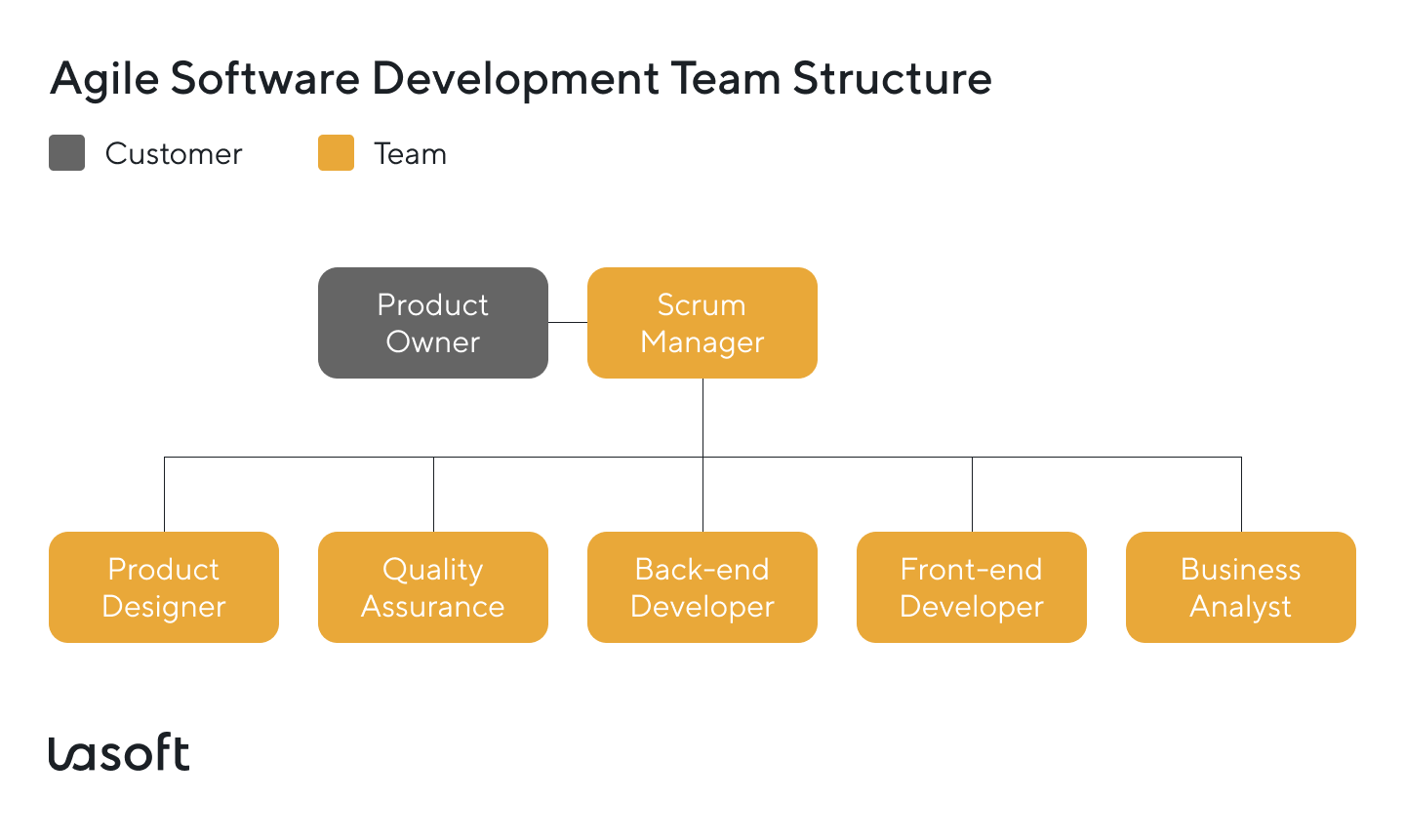
Collaboration, ownership, and flexibility are the key elements that enable an Agile software development team to work effectively. Every team member makes a valuable contribution to the development process, ensuring good quality and meeting the vision of stakeholders and the needs in the market. Agile teams operate as cross-functional groups of experts, where duties overlap, and collaboration drives their effectiveness.
- Product Owner
The Product Owner has got to be the team’s guide, transforming the client’s vision into the goals for the development team, they’re the main point of contact between the two groups. A good product owner keeps the team on track and ensures that the end product is exactly what the user wants and needs, something with actual market value. Essentially, the job involves continuous feedback, so the product can evolve and adapt to what the market is actually demanding at any given time.
Main responsibilities:
- The Product Owner establishes the product vision and ensures the team understands it.
- The PO is responsible for creating and prioritizing the most crucial features in the product backlog.
- During sprints, the Product Owner collaborates with the team to refine user stories and ensure that everyone understands the primary goal.
- He/she engages in communications with consumers, users, and business stakeholders to ensure the smooth progress of the project.
- Scrum Master
The Product Owner sets goals for what to build, and the Scrum Master ensures the team knows how to accomplish them. The Scrum Master is a team leader who guides the Agile process to ensure it runs smoothly and the team can operate flawlessly.
Main responsibilities:
- Helps out with sprint planning and daily stand-ups to make sure everyone knows what’s going on, reviews to see what went right and wrong and retrospectives to figure out how to make things better for next time.
- The Scrum Master has the task of keeping an eye on timelines, sorting out any conflicts around deadlines and then reflecting on it all with the team to figure out what’s slowing us down
- This manager is in charge of making sure everyone in the team gets and sticks to the Agile principles and follows the process.
- The Development Team in Agile
In Agile, developers are cross-functional, meaning they can perform all necessary tasks to turn a concept into a working, tested, and deployed product. A typical Agile development team may include:
| Frontend Developers | Create responsive interfaces that are interactive and user-friendly. Usually, they use programming languages and frameworks such as JavaScript, TypeScript, React, Angular, or Vue.js. |
| Backend Developers | Create the logic, APIs, and databases on the server side that enable the key features to function. |
| Full-Stack Engineers | Some teams hire full-stack developers who can work on both the front-end and back-end, making handoffs go more smoothly. |
| UI/UX Designers | Create intuitive experiences that are easy to understand and use, and collaborate closely with software developers to ensure they are user-friendly. |
| Quality Assurance (QA) Engineers and Testers | Usually, every sprint involves testing to identify defects early and maintain high quality. |
| Business Analysts | Assess the clients’ requirements and research to analyze competitors’ products and market demand. They focus on making user stories correctly, connecting business goals with technical implementation. |
| DevOps Engineers | Get the infrastructure running smoothly, automate deployments, and keep the CI/CD pipelines ticking over. |
| Data Scientists and AI Engineers | Use data analytics, machine learning models, and predictive features to give your product a real depth of intelligence. |
| Project Manager or Delivery Manager | The Project Manager or Delivery Manager is the one who keeps the timetables ticking, the finances in order, and ensures that all the different agile teams are working in sync. |
| Architect/Tech Lead | Sets the technical standards and helps developers make key design choices that are going to drive the product forward. |
What Does the Agile Approach Entail?
An agile mindset is all about self-organization, collaboration between people from different disciplines, and emotional intelligence; essentially, it’s about how well the team works together to accomplish the task. By adopting this approach, tasks get managed more efficiently, and the team can support each other more effectively.
Cross-Functional Teams: the Key to Success
We’ve said it before, but a cross-functional team is the best way to get the most out of a project; by bringing different skills and knowledge together in one team, you can eliminate waste, concentrate on the things that are going to drive the project forward, and end up with a product that really works on the market. These teams comprise individuals from diverse backgrounds, including web development, UI/UX design, quality assurance, project management, and more, who collaborate to deliver the best possible product.
It’s worth noting that each member of the team brings their own unique skills and experience to the table, and that is what really makes these teams work so effectively. The research all points to them delivering high-quality software solutions.
Self-Organization and Emotional Intelligence
Self-organizing teams enable quicker decision-making and more open reflection on how effectively they are building things.
Emotional intelligence in an agile team is all about managing stress and maintaining a positive team environment; essentially, it’s about how well team members get along with each other. Teams that work well in a collaborative atmosphere can effectively handle disagreements, support one another, and foster a positive work environment.
Best Agile Practices for Team Management
The key to managing an agile team is to adopt some key practices: iterative development, continuous feedback, and clear communication. These are crucial for maintaining flexibility, allowing for improvements, and ensuring that everyone’s needs are met. Agile Project Managers are really responsible for making this happen.
Software Development Process
Agile teams produce working software in short cycles, allowing them to receive feedback and make changes quickly; this is the foundation of the Agile methodology. During daily stand-ups the team will discuss what they’ve done and how they might adjust their plans to tackle new needs and ideas.
Feedback
Agile methods are all about getting feedback and continuous improvement; it’s about ensuring that every team member is on the same page and that processes are flexible enough to allow for changes to be made quickly.
Communication
- Seamless communication between team members makes every workflow run along smoothly:
- Using collaboration tools, such as Jira, Slack, Trello, etc. to keep the lines of communication open and frequent.
- Ensuring that everyone understands their role and responsibilities.
Collaboration Models: In-House vs. Outsourcing
For a lot of startups and SMEs the question is: should we hire in-house or partner with an external team? There are a few different collaboration models to choose from:
- In-House Team: You recruit your developers, designers, and managers as employees. You’ve got total control over the hiring and management process; it works well if you’ve got the capacity to invest in a permanent team and need tight integration with other departments. However, hiring can be slow and expensive, i.e. you carry all the overhead for salaries and benefits.
- Dedicated Nearshore Teams: As Lasoft exemplifies, you can engage a nearshore agile team. This means the external developers are geographically or culturally close (e.g., Eastern Europe for a US startup) and work full-time on your project. Lasoft’s nearshore model “seamlessly blends local tech talents with experience in global market cases”. Because nearshore partners share overlapping time zones and languages, real-time collaboration is easy.
Lasoft notes that minimal time differences enable daily stand-ups and fast feedback, which boosts project velocity. At the same time, nearshore teams offer cost efficiencies compared to local hiring: you avoid lengthy recruiting and pay competitive rates. This model is ideal if you want a dedicated team that acts like an extension of your company but without all the local payroll overhead. Lasoft even describes its approach as “clients lead, we develop”: you set priorities and we align our agile process to your needs. - Staff Augmentation: Here, you add developers from a partner firm to your existing team. This is flexible: if you need one mobile developer or a few data scientists for a limited time, staff augmentation is a suitable solution. The augmented staff integrates into your workflow. External specialists “attend your stand-ups, use your tools, and adhere to your timelines” while you retain control of tasks and priorities. This model reduces risk and costs (with no long-term commitment), and the augmented experts can immediately ramp up your team. It’s beneficial if you already have a core team but need to scale it quickly or cover a skill gap.
- Offshoring (Traditional Outsourcing): You contract a distant team to deliver the entire project. This can significantly reduce costs, but time zone and cultural differences may necessitate more coordination. For truly global products or simple projects, offshoring can be an effective solution. Lasoft cautions that nearshore is often preferable because it combines cost-effectiveness with smoother collaboration.
Summary
Mastering Agile structures is essential for achieving success in business development. Teams may work better by utilizing best practices such as an iterative approach, ongoing feedback, and clear communication. Agile teams that work successfully are cross-functional, can organize themselves effectively, and support one another during sprints.
Agile Glossary
| Agile | A flexible approach to software development based on iterative progress, collaboration with team and customer, and responsiveness to change. Agile teams deliver value in small, frequent increments. |
| Scrum | One of the most popular Agile frameworks organizes work into short, time-boxed cycles called sprints. |
| Sprint | A short development cycle, typically 1–4 weeks, during which the team focuses on delivering a specific set of tasks or product features. |
| Product Backlog | A prioritized list of features, enhancements, and bug fixes maintained by the Product Owner. It encompasses all potential work on the product. |
| Sprint Backlog | A subset of items from the product backlog selected for completion during a specific sprint. |
| User Story | A short, simple description of a feature told from the end-user’s perspective. Example: “As a customer, I want to reset my password so that I can access my account easily.” |
| Daily Stand-Up (Daily Scrum) | A short, 15-minute team meeting is held each day to synchronize progress and discuss issues. |
| Sprint Retrospective | A reflection session after each sprint where the team discusses what went well, what could be improved, and actions to take to enhance performance in the next sprint. |
| Scrum Master | The Scrum Master facilitates the Agile process by ensuring that the team follows Agile principles, overcomes issues, and supports a culture of collaboration. |
| Backlog Refinement | Backlog refinement is an ongoing process that involves reviewing and updating the product backlog to ensure that items are clearly defined and prioritized. |
| MVP (Minimum Viable Product) | The simplest version of a product that allows a team to validate assumptions and gather real user feedback quickly. |