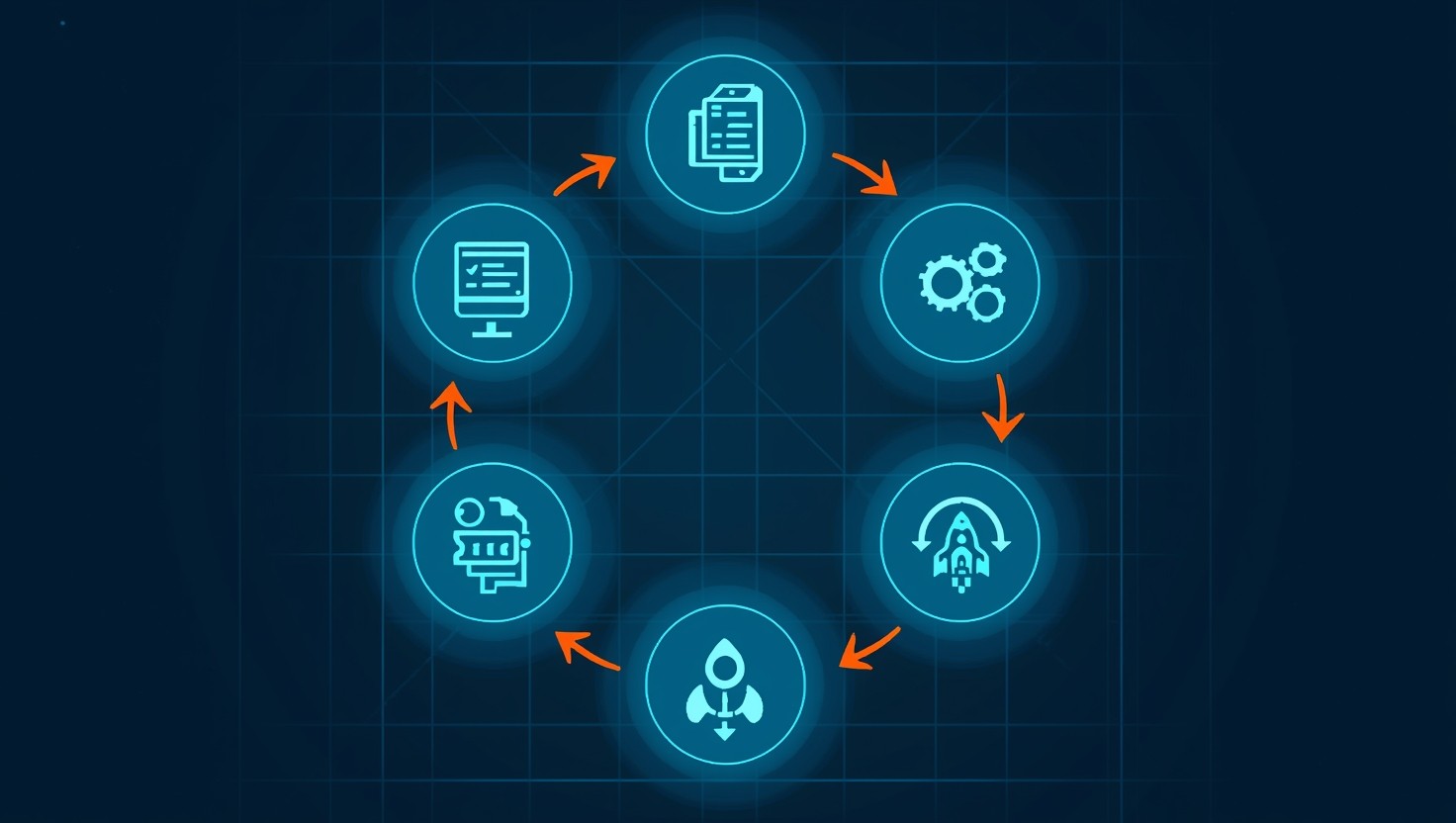

When we speak about outsourced IT support, we mean a professional team that takes on the burden of testing ideas in the complex digital market and guiding the development process, creating a fully fledged, successful product that meets the needs of a specific target audience in a specific field. Often, the in-house model is not a solution for startups, SMBs, and enterprises, and that’s when we want to discuss why and how the outsourced IT team can contribute to your shift in the market.
At LaSoft, we’ve observed a definitive change in tendencies as forward-thinking companies are no longer viewing outsourced IT as a “cost-cutting measure” but as a strategic upgrade. All reports show growth in the outsourcing services market, with a CAGR of 5.77%, underscoring the potential of outsourcing vendors.
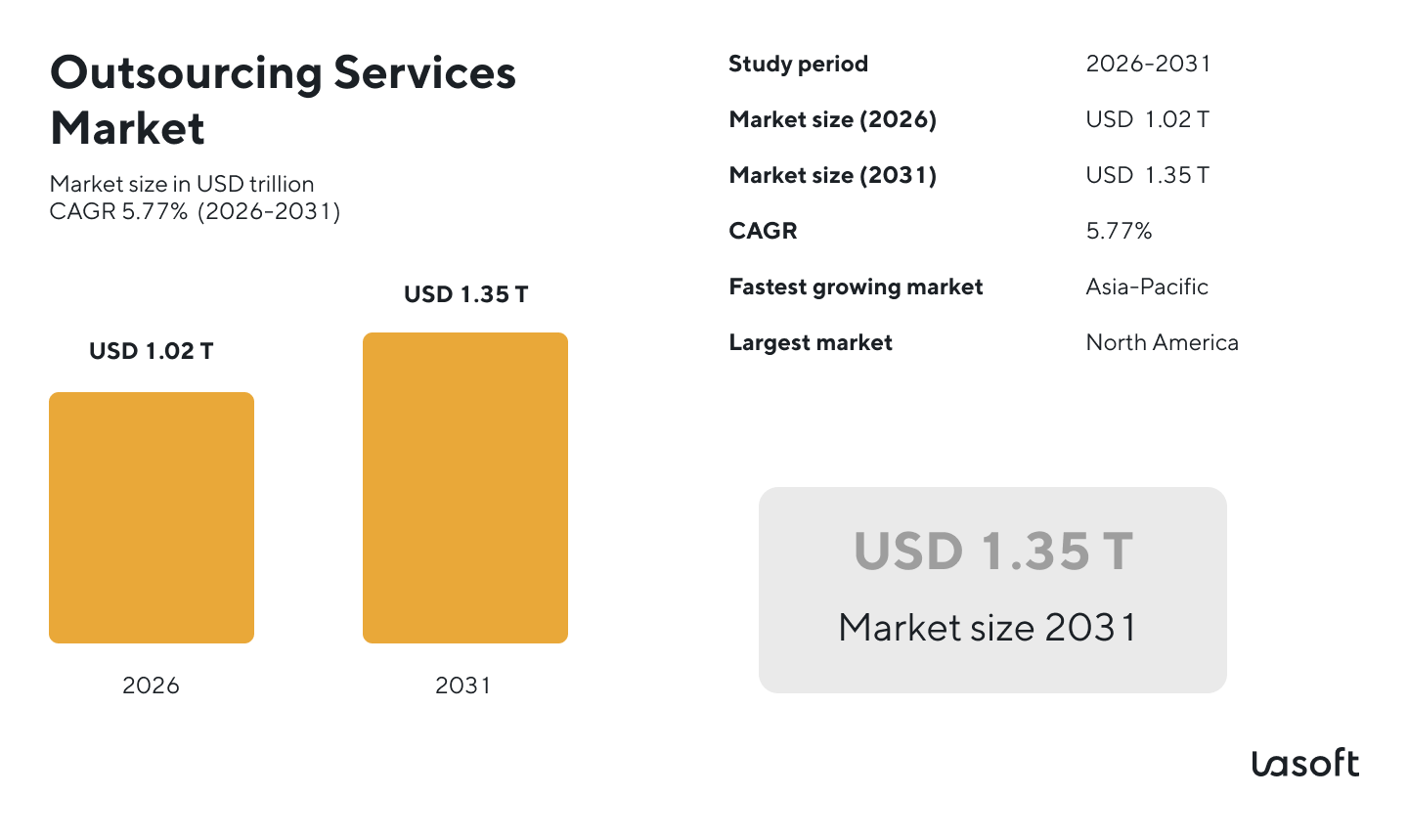
Source: Mordor Intelligence
Emerging Technologies and The Talent Gap
Innovative solutions are changing how we interact in the business environment. Workflow automation, digital transformation of IT infrastructure, AI agents, chatbots, and vibe coding are driving the trend toward third-party providers. An internal IT team of two or three people cannot realistically be experts in all the fields: cybersecurity, cloud architecture, AI integration, or help desk support simultaneously.
When you partner with an IT outsourcing company, you are hiring a vendor with a skilled staff and proven expertise to provide strategic guidance for the whole project as a dedicated team or experts for a staff augmentation model to support your internal team. As part of a cross-functional team, each member is an expert in their niche and in a specific field. For example, instead of one person trying to solve a complex database migration, you have a dedicated team that has already done it a dozen times for different clients and knows all the stages of the process.
Managed IT Services vs IT Outsourcing
When your goal is to stop worrying about cloud solutions, or if your servers are secure, or if your backups are running, a managed service provider is the best answer. However, if you are looking to build a specific software product or need a niche expert to guide you through a digital transformation or discovery, IT Outsourcing is the more efficient choice. At LaSoft, we often provide a hybrid approach combining managed services and outsourced software development.
Think of Managed IT Services as a holistic, long-term relationship in which the provider assumes ongoing responsibility for the health and success of your entire IT ecosystem. IT outsourcing is generally more project-based and involves hiring experts to perform specific work, audit your IT infrastructure, or complete a defined project that your internal IT team cannot handle.
Managed IT Services |
Outsourcing services |
|
| Focus | Ensure your systems are running. | Project execution |
| The Model | The model is typically based on a fixed monthly fee. | Often project-based, hourly paid, or involving a staff augmentation model. |
| Best for | These services are ideal for companies seeking a hands-off approach to infrastructure, 24/7 security, and strategic roadmapping. | Companies that aim to transform their business processes understand they need an IT strategy or additional expertise to develop or transform a software product. |
Tendencies in the Market: Popular Outsourced Technical Support Solutions
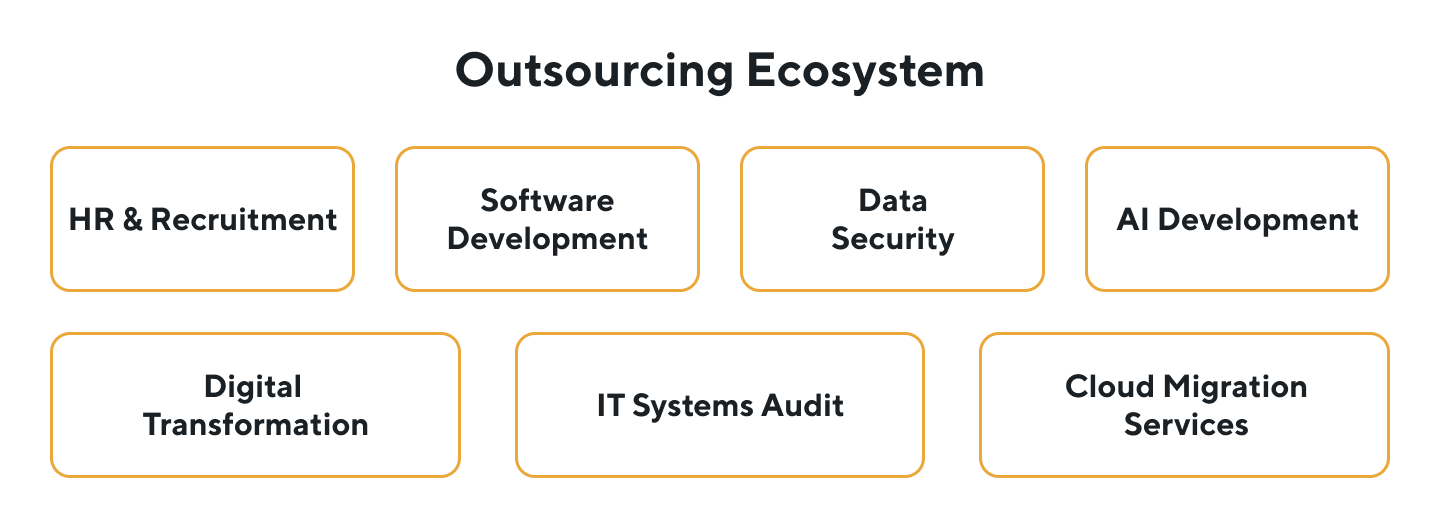
At Lasoft, as an IT outsourcing company, we have experts across industries and at every stage of the software development process. It’s common practice for companies to selectively outsource specific tech roles; the scope depends on business size, IT maturity, and long-term technology goals. Below are the most common outsourced tech roles, along with our advice on when to delegate.
Outsourced Help Desk
A help desk service provides your business with a team to contact when you need deep technical expertise to manage IT system issues. You may need support with everyday technical issues, including login problems, email errors, unresponsive software, or a malfunctioning laptop or printer. The primary purpose of service desk outsourcing is to quickly restore normal workflows so your in-house team can continue their tasks without downtime.
- What’s delegated: 24/7 end user support, hardware troubleshooting, and ticket management.
- The value: Businesses get a support team on a constant basis.
IT Consulting Services
IT consulting services provide expertise to help business owners and managers, whether they need to develop a new software product or innovate and automate the company’s infrastructure. IT consultants guide you through the audit process and help you build an IT strategy.
Effective IT consulting is a system of interconnected fields that together help businesses make better decisions, reduce the risk of launching new products, and embed emerging technologies into business workflows, turning them into measurable business assets. The strongest consulting engagements typically cover eight core areas: IT Strategy, IT Architecture, IT Implementation, ERP services, Systems Integration, Data Analytics, IT Security, and Software Management.
- What you get: You can avoid wasting budgets on unsuccessful product launches. You can also get a consultation on a possible digital transformation to automate your workflows.
- The value: Businesses can receive guidance on implementing changes to workflows, including automation, AI-driven personalized client services, testing product ideas in the market, discovery, and consulting on the best software solution to elevate business processes.
IT Audit and Due Diligence
An IT systems audit is an assessment of your technology environment, typically conducted by an external IT services provider, to identify hidden issues or improve performance as needed. The general practice is to order an audit before planning a cloud migration, a digital workflow transformation, or a merger. When you try to sell your software project or business, you also request due diligence.
Auditing helps businesses strengthen cyber resilience and prevent unexpected disruptions from technical debt and inefficient systems. Auditors provide business leaders with a clear, data-driven view of their tech infrastructure, helping mitigate the risk of inefficient systems functioning.
- What’s delegated: systems audit, due diligence before mergers or sales.
- The value: You get clarity on the state of your infrastructure and internal workflows. Audits will tell you whether systems can handle increased workloads, whether third-party integrations are secure, and whether the codebase is ready for transformation.
AI Development and Integration
AI development and integration services help businesses move from manual processes to automated and intelligent workflows. As your company scales, it faces increasing pressure to reduce time spent on routine tasks and to integrate multiple systems.
AI development services also allow companies to embed generative AI, AI agents, and retrieval-augmented generation. This enables the automation of document processing, data classification, personalized customer support workflows, and internal reporting. As a result, employees spend less time on repetitive work and more time on high-value activities that support business goals.
- What’s delegated: AI prompt engineering, machine learning model fine-tuning, and DataOps.
- The value: Businesses are searching for solutions and experts to automate internal workflows and integrate systems and tools into their IT infrastructure.
Cloud Services and DevOps
Cloud services, including platform migrations, are in high demand worldwide. Your outsourced team’s task is to audit your business operations and recommend the most suitable platform and pricing model. An outsourcing provider offers cloud services to help businesses design and improve their server environments. Your outsourced IT provider can consult you on pricing models and service ecosystems and recommend the cloud solution that best fits your unique needs. This strategic cloud consulting expertise helps clarify which workloads truly require hyperscale services, such as AWS or Google Cloud, and which can run more efficiently with alternative providers at a lower cost.
By evaluating compute, storage, networking, and bandwidth usage, DevOps teams can redesign infrastructure. They can conduct a professional audit and supervise your systems, which helps save money without compromising performance.
- What you can get: Cloud migration, server optimization, and CI/CD (Continuous Integration/Continuous Deployment) pipeline management.
- The value: A leading provider supports your strategic initiatives in the cloud environment optimization. Without a specialist, companies often overspend on cloud resources they don’t actually use.
Quality Assurance and Testing
Outsourcing QA and testing enables you to launch quality, bug-free products to market. QA teams’ expertise covers all types of testing: manual, automated, and AI-powered. QA support teams collaborate closely with your developers and DevOps teams, ensuring quality and testing are a part of the delivery pipeline from the initial stage. That means your team can continue delivering high-quality releases consistently and maintain your high standards.
- The QA team handles manual testing, automated regression suites, and load testing.
- The value: You launch your product faster while maintaining your standards.
Cybersecurity Services
With cyber threats and a global shortage of cyber experts, this field remains one of the most well-compensated career paths. Cybersecurity experts protect businesses from digital threats by analyzing risks, anticipating attack methods, and thinking from an attacker’s perspective to prevent incidents.
Security analysts focus on continuous monitoring and incident response, tracking suspicious activity, investigating potential breaches, and assessing vulnerabilities.
Security specialists design, build, and operate security systems; manage security architectures; install security tools; and develop strategies to keep your networks safe.
Ethical hackers attempt to breach systems in a controlled manner, using the right tools to simulate what a real-world hacker would do. They identify weak points, document risks, and help teams fix problems.
- What’s delegated: Real-time threat monitoring, penetration testing, and compliance auditing (GDPR, SOC2, HIPAA).
- The value: Access to enterprise-grade threat intelligence and proactive defense strategies that are too expensive to build internally.
In-House IT vs Outsourced IT Support: Simple Comparison
| In-House IT Team | Outsourced IT Support | |
| Cost structure | Fixed costs: salaries, benefits, taxes, training, tools | Agreed on monthly costs or flexible pricing. No extra training or retention expenses |
| Hiring and scaling | Expensive and long recruitment process, hard to scale quickly | Fast access to specialists, easy to scale up or down |
| Skills | Limited to the skills of a small team | A range of expertise (cloud, security, QA, DevOps, AI, support) |
| Working hours | Business hours | You can agree on 24/7 support options |
| Risk management | No know-it-all expertise | Shared responsibility, backup expertise, structured approach |
| Technology coverage | Often focused on core systems only | Covers infrastructure, security, cloud, applications, and support services |
| Flexibility | Predefined team structure | Flexible engagement models, including dedicated teams, staff augmentation, and project-based work, are available. |
| Access to emerging technologies | Limited by hiring and budget | Easier access to specialists in cloud, AI, automation, and security |
| Best fit for | Companies with narrow IT needs | Growing businesses, complex environments, or scaling companies |
Is There a Vendor Dependency When You Hire an Outsourced IT Provider?
Business leaders worry about becoming dependent on a support provider by giving control of their IT infrastructure. It’s not an unreasonable fear, but it depends on how you build your partnership from the initial stage. A professional IT provider offers transparent processes, authority clearly defined in documentation, and shared access to systems and configurations. That way, your infrastructure, code, and specialized knowledge aren’t locked up in a proprietary tool or vendor’s head; they’re yours to keep and use, no matter what happens in the future.
The opposite situation is a true vendor dependency, which tends to creep in when companies rely on tools, undocumented processes, or closed ecosystems that make switching vendors costly and nerve-wracking. External vendors can also succumb to this trap. The key is to prevent this situation by utilizing open standards, adhering to industry best software engineering practices, and sticking to well-known platforms that any competent team can utilize. This ensures that you won’t feel trapped if you decide to move on.
From a business standpoint, outsourcing should actually enhance your flexibility. If your contract includes clear exit clauses and a plan for knowledge transfer and ownership of the intellectual property you’re paying for, you can take advantage of the operational benefits of the outsourcing support model without being stuck with a single provider.
LaSoft Is a Partner for Outsourced IT Support
As an outsourced IT support provider, our team focuses on building long-term, transparent partnerships and offers expertise in software engineering, cloud migration, DevOps, QA, and AI automation under a single delivery model. We can support businesses with day-to-day IT operations and complex transformation initiatives.
What makes LaSoft reliable for clients is our nearshore delivery model and a solid portfolio of successful cases, as we have been working in the international market for more than 10 years. Our experts can operate as an extension of your internal team or as an agile, dedicated team, optimizing costs and enabling reliable collaboration.
Flexible Cooperation Models
| Dedicated Team Model | A professional team understands your needs and fully aligns with your business goals. This model works best for companies that need long-term IT support, workflow transformation, or long-term product development. The team manages your project in line with the operational rhythm, business processes, priorities, and roadmap. |
| Staff Augmentation | When you need specific expertise, such as cloud engineers, DevOps specialists, QA engineers, or cyber experts, you choose specific skills to add to your IT department. The overall idea behind staff augmentation is to scale quickly, fill skill gaps, and accelerate critical initiatives without lengthy hiring cycles. |
| Project-Based Collaboration | Clients seek a fixed scope for specific tasks with clearly defined goals, such as infrastructure audits, cloud migrations, or automation initiatives. This model fits companies that need results within a specific timeframe or want to validate us as an outsourced IT provider before moving to a long-term engagement. |
| Hybrid Model | Many US and European companies choose a mix: a small, dedicated core team plus on-demand specialists with specific skills. This approach balances cost control, flexibility, and access to deep expertise. |
Final Recap
When we discuss outsourced IT support, we often note that it reduces operational costs, but we also mean it has become a strategic approach to managing rising technological complexity, closing talent gaps, and accelerating digital transformation for startups, SMBs, and growing enterprises.
We’ve shown how companies can selectively outsource critical functions, including help desk support, IT consulting, AI development, cloud and DevOps, QA and testing, and cybersecurity. And how it’s vital to choose a professional team that follows transparent practices and clear documentation.