
Global supply chains have become too complex to manage with dashboards alone. Every shipment generates a stream of signals—GPS coordinates, traffic updates, warehouse capacity alerts, customer requests, weather disruptions. Logistics teams monitor these signals through control tower systems, yet the real challenge is not visibility. It is the ability to interpret this constant flow of information and make timely operational decisions.
Dispatchers and operations managers still carry most of this burden. They track delays, coordinate drivers, adjust routes, notify partners, and resolve exceptions across multiple platforms. As shipment volumes grow and delivery expectations tighten, the number of micro-decisions required each day increases dramatically. Even well-equipped control towers can become overwhelmed.
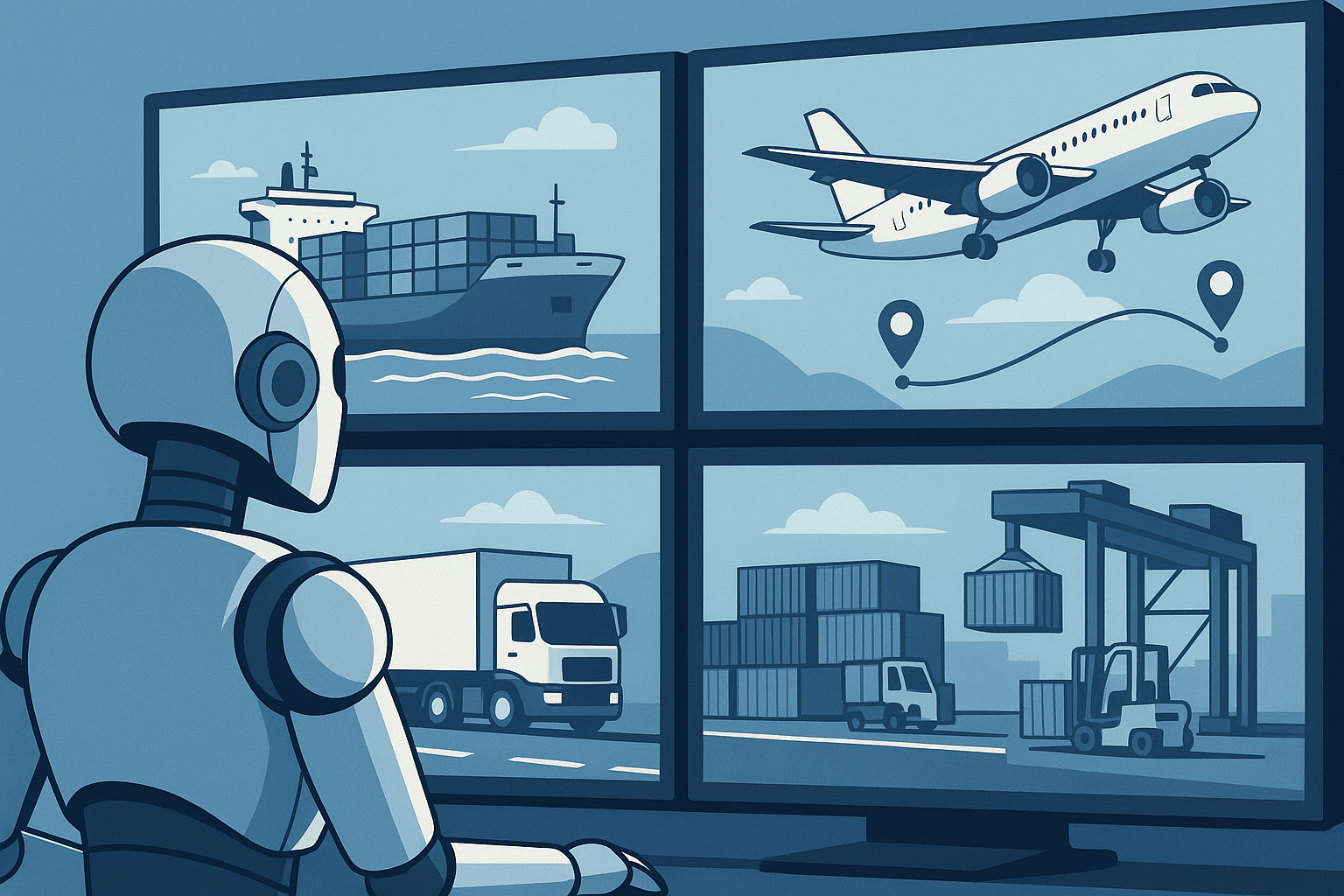
This is where a new operational layer is beginning to emerge: AI agents embedded into logistics control towers. Instead of simply displaying data, these systems continuously analyze incoming signals, detect potential disruptions, and suggest—or in some cases initiate—operational actions.
In other words, the control tower is gradually evolving from a monitoring interface into a decision-support environment, where AI agents assist human operators in coordinating the movement of goods across increasingly complex logistics networks.
What a Logistics Control Tower Actually Does
The term “logistics control tower” is often used in marketing presentations, yet in practice it refers to a very specific operational function. A control tower is not simply a dashboard. It is the central coordination layer of the supply chain, where information from multiple systems is aggregated and operational decisions are made.
Typically, a logistics control tower integrates data from transportation management systems, warehouse systems, telematics platforms, GPS tracking, carrier portals, and customer order management tools. These sources provide a continuous stream of operational signals about the movement of goods.
The role of the control tower team is to interpret this information and maintain the stability of the logistics network. When shipments are delayed, when a driver misses a pickup window, when weather conditions disrupt a route, or when warehouse capacity suddenly changes, operators intervene to restore the flow.
In practice, the control tower acts as the operational brain of logistics operations. It monitors what is happening across the network and coordinates the responses required to keep shipments moving.
However, the effectiveness of this system depends heavily on the ability of human operators to continuously process incoming information and react quickly. As shipment volumes grow and logistics networks become more interconnected, the number of signals that must be interpreted increases dramatically.
This growing complexity is precisely why companies are beginning to explore ways to augment control towers with AI-driven decision support.
The Limits of Human Coordination
Even the most advanced logistics control towers ultimately rely on human coordination. Dispatchers and operations managers monitor incoming data, identify disruptions, and decide how the network should respond.
This model works well at moderate scale, but it begins to strain as logistics operations grow more complex.
Every shipment moving through a network generates multiple operational signals: location updates, traffic changes, weather alerts, warehouse availability, carrier confirmations, and customer requests. When hundreds or thousands of shipments are in transit simultaneously, the number of signals that must be interpreted becomes enormous.
Human operators must constantly move between different systems—transportation platforms, communication tools, dashboards, and spreadsheets—while maintaining situational awareness across the entire network. The process is cognitively demanding and difficult to scale.
As a result, logistics coordination often becomes reactive. Teams respond to disruptions after they occur rather than anticipating them. A delay is detected when a shipment misses a checkpoint. A route is adjusted when traffic congestion has already slowed the vehicle. Notifications are sent only once the disruption has become visible.
These limitations are not the result of poor management or inadequate systems. They reflect a fundamental constraint: human attention is finite, while modern supply chains generate an almost continuous stream of operational events.
This imbalance is precisely the problem AI agents are designed to address.
Where AI Agents Fit Into the Control Tower
AI agents introduce a different operational model. Instead of relying exclusively on human operators to monitor dashboards and interpret signals, the system continuously analyzes incoming data and identifies situations that require attention.
In a logistics control tower, an AI agent can observe multiple data streams at once—shipment status updates, route conditions, driver availability, warehouse capacity, and external factors such as traffic or weather. Rather than presenting this information passively on a screen, the agent evaluates patterns and looks for deviations from expected performance.
When a potential disruption appears, the system can generate operational recommendations. For example, it may suggest rerouting a shipment around emerging traffic congestion, reallocating a vehicle to cover a delayed pickup, or notifying a warehouse team about a change in arrival time.
The key distinction is that the AI agent does not replace the control tower. Instead, it becomes an additional operational layer embedded within it. Human operators remain responsible for overseeing the network, but the AI system performs continuous monitoring and surfaces the events that actually require intervention.
In this way, the control tower begins to evolve from a system that primarily displays information into one that actively assists with operational decision-making.
To better understand this shift, it is useful to compare how traditional control towers operate versus those augmented with AI agents.
| Operational Aspect | Traditional Control Tower | AI-Assisted Control Tower |
|---|---|---|
| Monitoring shipments | Human operators track dashboards and alerts | AI agent continuously monitors multiple data streams |
| Detecting disruptions | Issues noticed after delays or missed checkpoints | Predictive analysis identifies risks before disruptions occur |
| Decision making | Dispatchers manually evaluate options | AI suggests operational actions and alternatives |
| Communication | Operators notify drivers, warehouses, and clients | Automated notifications triggered by AI workflows |
| Operational scale | Limited by human attention and staffing | Scales with data processing and automation |
| Role of operators | Constant monitoring and reaction | Supervising AI insights and handling complex decisions |
This transformation does not eliminate the need for experienced logistics professionals. Instead, it changes their role—from continuously watching the system to managing exceptions and making higher-level operational decisions.
From Monitoring to Predictive Coordination
One of the most significant shifts introduced by AI agents is the transition from reactive operations to predictive coordination.
Traditional logistics control towers primarily detect problems once they become visible. A shipment is marked as delayed after it misses a checkpoint. A dispatcher notices congestion when a vehicle stops progressing along its route. A warehouse team is notified only when a truck arrives later than expected.
AI agents operate differently because they analyze patterns across historical and real-time data simultaneously. Instead of waiting for disruptions to occur, the system evaluates signals that indicate a disruption may soon happen.
For example, traffic data combined with route history may suggest that a shipment will encounter severe congestion within the next hour. Weather alerts may indicate that a delivery corridor will soon experience delays. Warehouse capacity signals may reveal that a planned unloading slot will no longer be available.
In such cases, the AI agent can recommend adjustments before the disruption materializes. A route may be changed earlier, a shipment may be rescheduled, or a warehouse team may be notified in advance.
This predictive capability fundamentally changes the role of the control tower. Rather than acting as a monitoring center that reacts to events, it begins to function as a proactive coordination system that continuously anticipates and mitigates operational risks.
For logistics companies operating complex networks, this shift can significantly reduce delays, improve fleet utilization, and stabilize delivery schedules across the supply chain.
Challenges and Implementation Considerations
Despite the promise of AI-driven logistics coordination, implementing AI agents inside real operational environments is rarely straightforward. Logistics systems are typically built around a complex landscape of platforms—transportation management systems, warehouse software, telematics solutions, carrier portals, and internal enterprise tools.
For an AI agent to function effectively, it must be able to interact with these systems reliably. This usually requires well-designed APIs, data pipelines, and secure integrations that allow the agent to retrieve operational data and trigger workflows without disrupting existing processes.
Another important consideration is decision transparency. Logistics operators must understand why the system recommends a certain action—whether it is a route adjustment, a resource reallocation, or a delivery notification. Without clear explanations, operators may hesitate to trust automated recommendations, particularly in situations that involve financial or operational risk.
There is also the question of operational boundaries. Not every decision in logistics should be automated. Many organizations adopt a hybrid model in which AI agents handle monitoring, analysis, and routine coordination tasks, while human operators retain authority over high-impact decisions such as major rerouting, contract negotiations, or customer escalation cases.
Finally, successful implementation often depends on gradual adoption rather than full system replacement. AI agents typically deliver the best results when introduced incrementally—first supporting monitoring and communication tasks, then expanding into predictive analytics and workflow automation.
In this way, the goal is not to replace existing logistics infrastructure but to augment it with an intelligent operational layer that helps teams manage growing supply chain complexity more effectively.
The Emerging Role of AI-Driven Logistics Control Towers
Logistics control towers have already evolved significantly over the past decade. Early systems focused mainly on visibility—tracking shipments and displaying operational data in centralized dashboards.
The next phase is about operational intelligence.
AI agents introduce a new layer that continuously analyzes logistics signals and assists with decision cycles that previously required constant human attention. Instead of manually monitoring hundreds of shipments, operators interact with systems that highlight only the situations requiring intervention.
Over time, this model may transform the role of control towers themselves. Rather than functioning primarily as monitoring centers, they increasingly become coordination hubs where human expertise and automated decision support operate together.
For logistics companies managing large freight networks, the difference is significant. Better prediction of disruptions, faster communication across partners, and more efficient fleet coordination can improve reliability while reducing operational overhead.
In this sense, AI agents do not fundamentally change the goals of logistics operations. Goods still need to move from origin to destination as efficiently as possible. What changes is the speed and scale at which operational decisions can be made.