

Climate change and a rapidly growing population leave millions with no choice but to live without access to a vital resource: clean water. UNICEF research shows that 2 billion people face water shortages, and the problem is worsening by the day, especially for island nations where rising temperatures are turning farmland into waste.
Emerging technologies are addressing this complex crisis: large companies and small startups are directing their expertise toward wind and solar energy, AI, and software engineering to develop solutions that deliver clean water without leaving a massive carbon footprint.
Let’s examine the complex problems caused by water insecurity, land degradation, and our overreliance on energy, and explore how deep tech will help address them.
Despite all efforts, 2.1 billion people still lack access to even the most basic safe drinking water.
Nearly 1.4 billion people rely on unreliable supplies, 287 million get by on limited services, 302 million resort to the nearest muddy ditch or river, and 106 million still drink directly from the tap. The UNICEF research provides these shocking statistics.
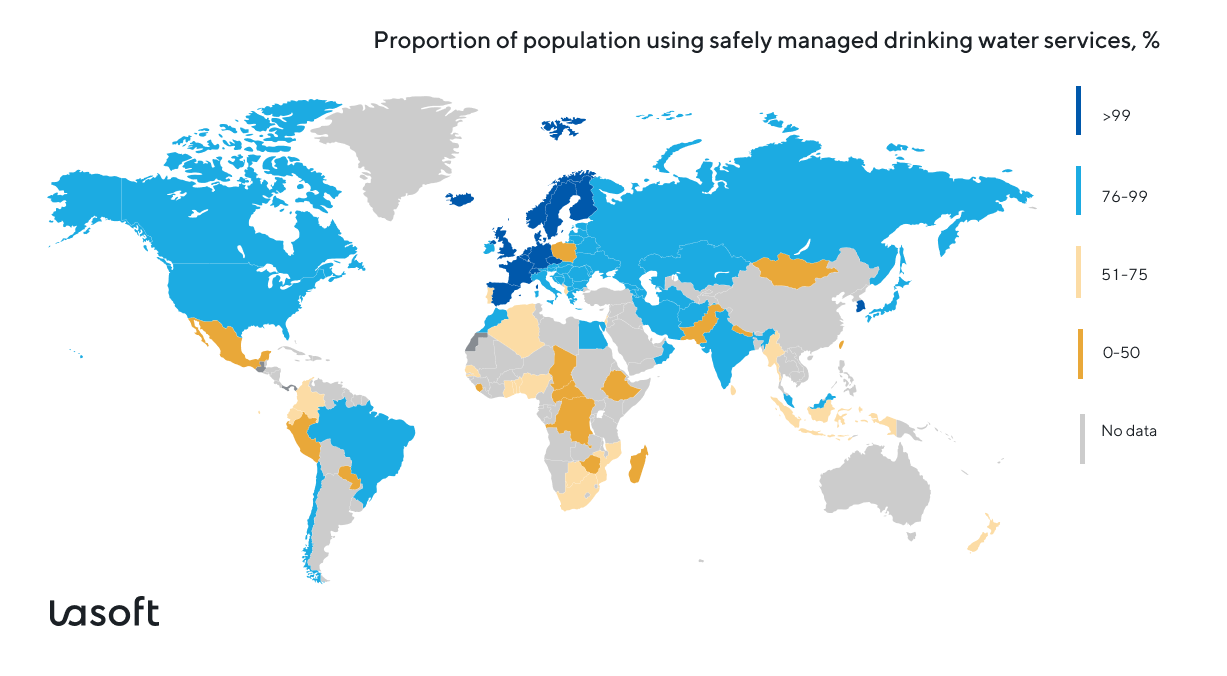
Jamaica: The situation is challenging, as approximately 40% of the population lacks reliable access to water, and the island is under frequent droughts. The government’s only solution was to ration water to only a few hours per day.
Dominican Republic: Only 45% of the population has access to a safely managed drinking-water service (2024). Source: UNICEF
Barbados (Caribbean): Groundwater recharge is only about 15%–30% of annual rainfall, and, with the influx of tourists, during water rationing, water is diverted to hotels first and then to public places. This practice leaves local residents without water for hours or even days. Source: Preventionweb.net
Mexico City (Mexico) faces severe water shortages, pollution, and aging infrastructure, all of which require sustainable management. Water scarcity and drought permanently affect the country, requiring sustained investment. Source: Smartwatermagazine
In the Middle East, drinking-water security is increasingly tied to desalination; for example, Kuwait obtains approximately 90% of its drinking water from desalination, while the UAE reports that about 42% of total water demand is met by desalination plants. Source: Time
Drinking Water Supply Is Becoming Less Guaranteed in the EU
Across the EU, the largest near-term risk to drinking water is that water availability becomes less reliable, more seasonal, and more uneven across regions, particularly under more frequent and severe drought. The European Parliament’s foresight study notes that water stress already affects about 30% of Europe’s population each year and roughly 20% of the territory, with climate change expected to intensify both the duration and severity of scarcity, particularly in Mediterranean regions.
Freshwater scarcity tends to cluster in regions where hotter summers, intensive irrigation, tourism peaks, and heavy water use push rivers and aquifers close to their limits. The highest risk is in Southern Europe, especially in Spain, Italy, Greece, and Portugal, where arid climates combine with high agricultural water demand.
Small island states are particularly vulnerable. The report notes that Cyprus and Malta face scarcity conditions across their entire populations, and that during summer, water use in the Mediterranean can reach nearly 100%, placing additional pressure on groundwater and accelerating depletion risks.
Even in Northern and Western Europe, droughts can cause shortages, especially in river basins with high industrial and urban water demand. The same study identifies Belgium and the Netherlands as countries that experience water shortages during drought periods.
Eastern Europe also shows early warning signs. The study highlights pressure on groundwater resources in parts of Poland, Romania, and Bulgaria, linked to insufficient rainfall and high agricultural demand, indicating that water stress is spreading beyond traditional hotspots.
In Great Britain, the stress is concentrated in southern and eastern England. UK policy reports identify multiple water company regions as experiencing “serious water stress,” including major providers serving the London–South East corridor and parts of East Anglia. Source: EuroParl
Water Scarcity – Not Fiction, but Our Everyday Reality
We take drinking water for granted, but for too many people, it’s a luxury they can’t afford. It’s no wonder scientists are seeking for solutions and technologies to get us clean drinking water when you consider just how essential it is to our health and our quality of life.
You’d think the Earth has plenty of water, but the vast majority of it isn’t safe to drink. 71% of the Earth’s surface is covered by water, but 97.5% of that is saltwater.
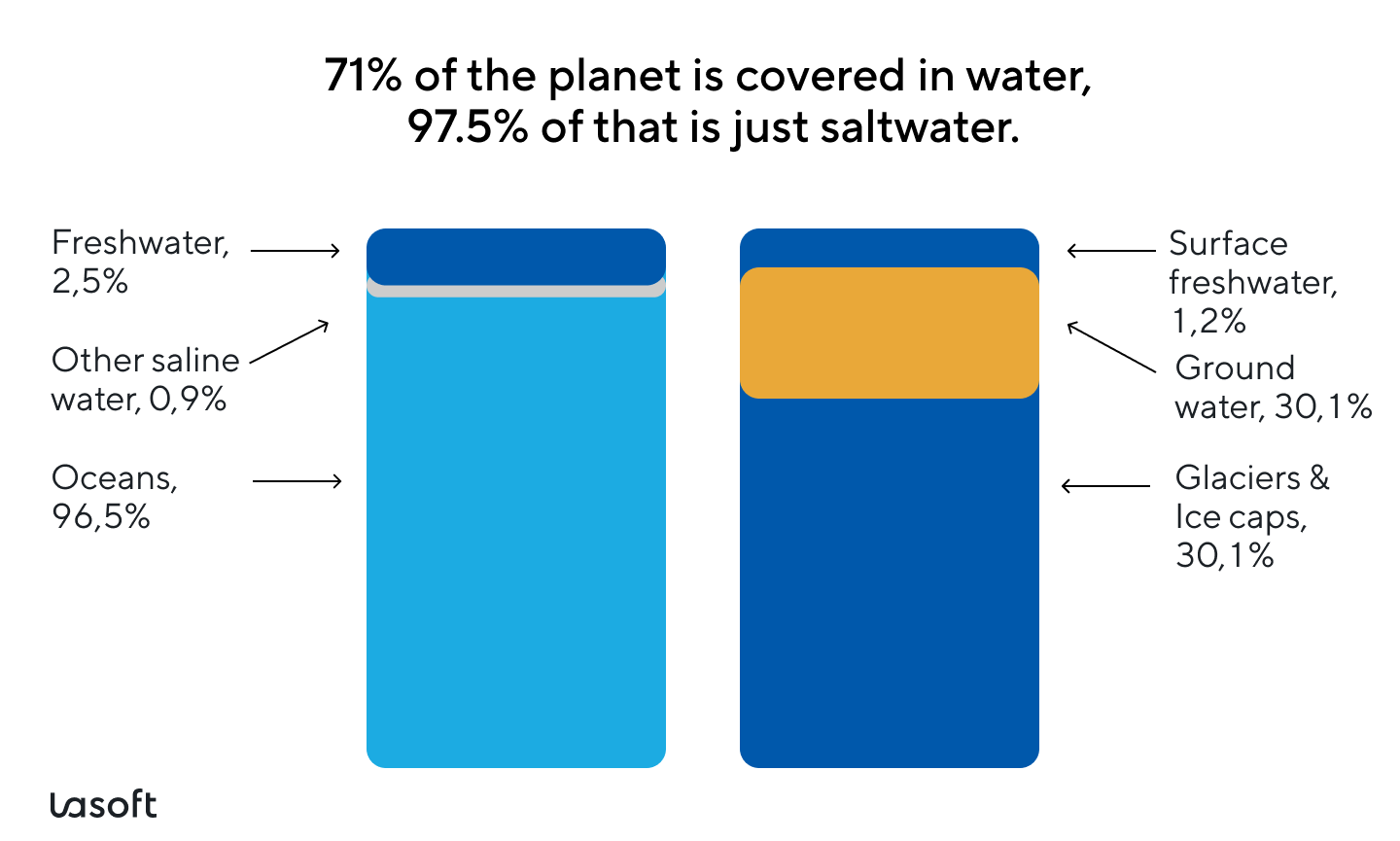
Things are looking pretty dire here on our planet. The population is growing, industries are expanding, and we’re consuming more water as cities continue to expand, and all the while, our pollution is taking a toll on the resources we do have.
Climate change isn’t helping; it’s causing extreme weather that’s affecting our water supplies and degrading our old infrastructure. We’re talking floods, storms, and hurricanes, all of which can contaminate our water and cause damage.
Soil Erosion and the Role It Plays
Clean water is essential for farming to continue, even when it gets hot and dry. However, when climate change intensifies heavy rainfall, the good topsoil is washed away and ends up in rivers and the sea. In the long run, it only worsens. The soil increasingly requires more water and additional inputs to produce yields, which in turn demand larger budgets and greater water availability, both of which are currently in deficit.
Types of Solar Desalination Systems
In solar stills, two simple effects do most of the work: heat from the sun drives evaporation, and sunlight exposure helps inactivate pathogens. The catch is that solar radiation is intermittent and uneven, so practical solar desalination systems capture and use it in a more structured manner. These methods can be grouped into three main groups:
- Solar-thermal desalination, which uses solar collectors to convert sunlight into usable heat.
- Solar-electric desalination relies on photovoltaic (PV) or concentrated photovoltaic (CPV) technology to generate electricity for the desalination process.
- Hybrid solar desalination improves reliability and effectiveness by combining heat and electricity or by employing multiple desalination techniques.
1) Direct solar thermal desalination
In solar-thermal desalination, the sun’s radiant energy is captured and converted into usable heat. That heat can drive direct distillation, where evaporation and condensation occur within a single enclosed unit, or it can be converted into electrical or mechanical energy, as in solar-thermal power plants.
This approach tends to perform best in regions with strong solar resources, typically estimated at 2,200–2,400 kWh/m² per year of solar radiation. Solar stills are the most common and the most affordable solar-thermal option, but they typically produce a relatively low volume of fresh water, around 1–4 liters per square meter of collector area.
Because of this limitation, many researchers focus on improving solar desalination performance by increasing evaporation and condensation rates and reducing heat losses so that captured solar energy is used to produce clean water rather than being lost to the environment.
Best for: very small-scale needs, off-grid situations, low complexity, education/demos, emergencies, or niche use.
2) Solar-electric desalination (PV-powered desalination)
Solar-electric desalination starts with a simple idea: convert sunlight directly into electricity using semiconductors, the most common of which are photovoltaic (PV) cells. PV systems are relatively easy to deploy and, depending on the setup, can operate even without batteries.
One major advantage is versatility: PV electricity can power many desalination processes, such as reverse osmosis processes and thermal-hybrid configurations, because electrical energy is a universal input. Over the past decade, PV-powered desalination has become more competitive as solar cell lifespans and performance improve and as systems are increasingly designed to work alongside conventional energy sources (as a backup or supplement).
A practical challenge, however, is soiling: dust and grime that settle on panels and reduce output. Studies consistently show that energy losses from soiling depend on local weather conditions and are rarely uniform; therefore, routine cleaning is essential.
Researchers also examine how PV electricity can be integrated with various desalination configurations.
Best for: modular deployments, brackish or salty water (RO), easier scaling, and sites where electricity from PV is straightforward.
3) Hybrid Solar Systems
Hybrid solar desalination is essentially a universal approach. A hybrid system combines two or more desalination technologies, offering the strengths of each, often pairing thermal distillation methods with membrane-based desalination.
Studies have indicated that hybrids are a more economical option because they can lower overall energy demand, reduce scaling and fouling risks, improve recovery rates, and ultimately lower the cost per liter of desalinated water by boosting both efficiency and output quality.
Combinations of reverse osmosis (RO) and RO–MED (multi-effect distillation) are increasingly used in desalination and power plant contexts because they offer more stable operation and facilitate the delivery of drinking water that meets local and international quality standards, while handling byproducts in a more controlled and simplified manner.
Best for: water-scarce regions where energy efficiency, reliability, waste management, and pure output matter.

A Jamaican Startup Offering Solar Desalination Solution
In our article, we present Phinetic, one of three climate entrepreneurs representing Jamaica in Europe.
Phinetic is a startup developing a Hybrid Solar Desalination System (HSDS) built for island and coastal regions where water supply is unreliable and energy costs are high. What makes this team approach feel different is that they’re not treating desalination as “just water production.” They’re treating it as resource production and trying to do it in a way that’s cleaner and more circular.
We should note that traditional desalination has helped many regions secure drinking water, particularly through mainstream methods such as Reverse Osmosis (RO) and Multi-Stage Flash (MSF) distillation.
First, these systems are typically energy-hungry. That matters because, in many countries, the electricity used to power desalination still comes mainly from fossil fuels. While desalination solves a water problem, it can quietly exacerbate an emissions problem, especially at scale.
Second, desalination doesn’t just produce fresh water. It also produces a highly concentrated brine, which is a saline byproduct that must be disposed of. In coastal settings, the solution often means discharge back into the sea. The issue is that brine can be denser than seawater, altering local conditions and creating stress on nearby marine ecosystems.
And those ecosystems are not abstract. Brine discharge and associated chemicals can contribute to environmental damage, including harm to coral reefs and seagrass beds: habitats that protect coastlines, store carbon, and support fisheries. For island regions and tourism-dependent economies, degrading marine life is not just an ecological cost; it’s also an economic one.
Phinetic’s HSDS is designed to run on 100% solar power, and instead of dumping brine back into the ocean, it aims to keep the process closed-loop and crystallize salt as a usable byproduct. So rather than creating a waste stream that requires “damage control,” it produces two outputs: freshwater and salt.

Phinetic’s HSDS: Solar Desalination System
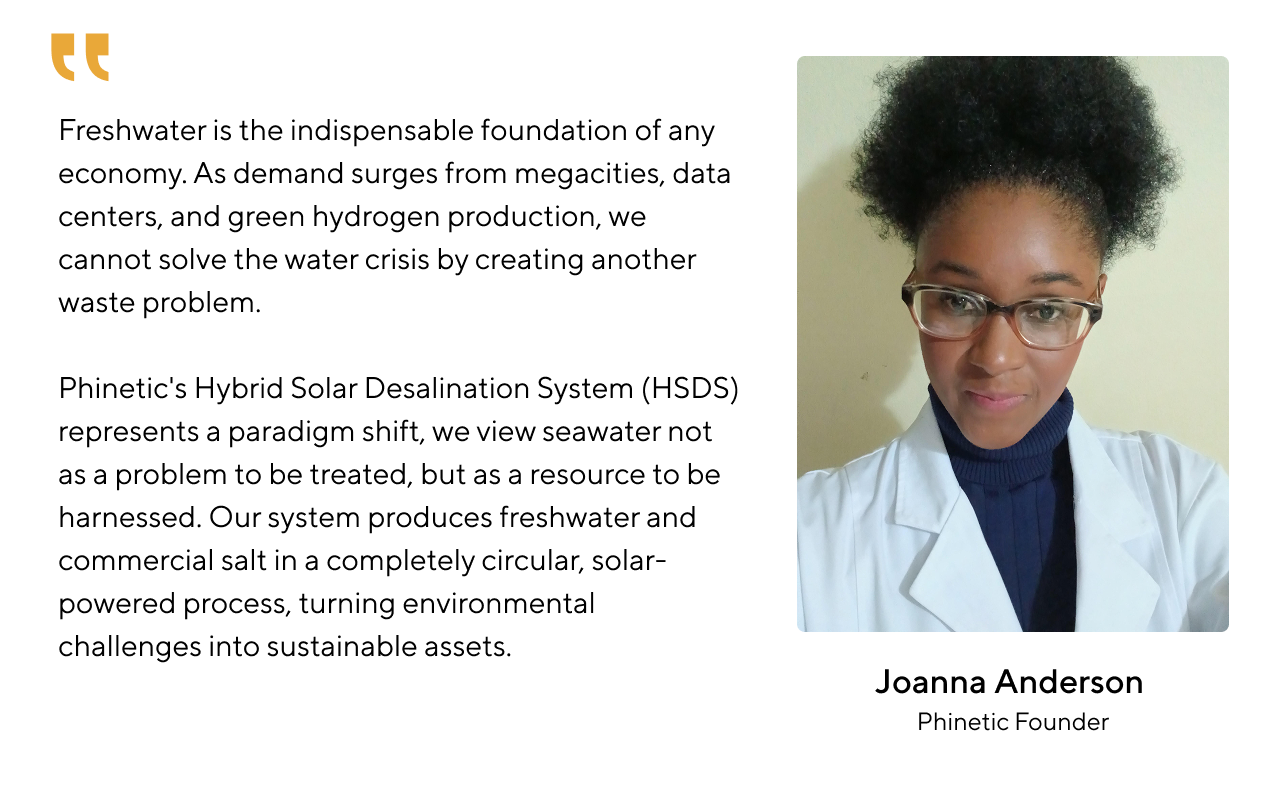
Let us introduce Jamaica’s startup Phinetic, with its Hybrid Solar Desalination System (HSDS), designed for places where water reliability, energy prices, and ecosystem protection are all part of the same equation. Unlike other products that focus solely on producing fresh water, Phinetic’s HSDS is a system that produces both potable water and sea salt using 100% solar energy.
According to the product overview, HSDS is designed around three pillars:
| Sustainable output | Water and salt simultaneous production.
The system produces approximately 15,000 liters of water and 1,500 kg of salt daily. |
| Environmental protection | This method prevents damage to marine ecosystems, as it’s a closed-loop system that eliminates the discharge of hypersaline brine. |
| Climate Change Mitigation | 100% Solar-Powered Operation. This system effectively reduces approximately 30-50 tons of carbon emissions annually. |
| Energy efficiency | The system utilizes a passive vacuum system to minimize energy consumption. |
| End-of-Life Management | Disposal or recycling of components at end-of-life (e.g., solar panels, batteries). |
Final Recap
While solar desalination can significantly improve water-stressed regions, its practical implementation always entails trade-offs. We aim to advise on practical factors that determine whether a system succeeds in practice and to assess it as a workable solution.
| 1) Sunlight isn’t constant | Solar output drops at night and during cloudy days. Ask the producer whether the system has a plan for continuous cycles, including batteries, thermal storage, and backup power. |
| 2) Maintenance | Key components such as filters, pumps, membranes (for RO), and pipes require routine servicing. Salt corrosion and scaling can increase maintenance needs. |
| 3) Brine/byproduct handling | All systems, even “closed-loop” systems, require clear operational logic. Where does any remaining concentrate go? How is salt stored and processed, and what occurs during downtime or cleaning cycles? Always ask the producer these questions. |
| 4) Water quality verification | Safe drinking water requires regular testing, monitoring, and clear standards. The best systems make quality checks simple and repeatable, and any specialist can fix them. |
| 6) Economics depend on your place of residence | Cost per liter varies with solar resource, land availability, labor costs, and logistics. A system can be technically sound but financially mismatched to a region. |
Ultimately, solar desalination is an infrastructure, and the most promising systems are those designed for real-world conditions: variable sunlight, limited maintenance capacity, sensitive coastlines, and strict drinking-water standards. If a solution can meet these constraints without hidden costs over time, it has a strong chance of moving from pilot projects to reliable daily use.
FAQs
How does solar desalination work?
What are the main types of solar desalination systems?
- Solar-thermal: in this process, heat drives distillation.
- Solar-electric systems are powered by photovoltaic (PV) or concentrated photovoltaic (CPV) panels. These provide the electricity required for desalination, often employing reverse osmosis (RO) as the primary process.
- Hybrid systems combine two or more methods within a single system to enhance stability and efficiency.
What’s the difference between direct and indirect solar desalination?
- Direct: This occurs when desalination takes place within the device that captures solar energy (e.g., a solar still).
- Indirect: here, the solar energy is captured separately (with PV panels or solar collectors) and then used to power a desalination process (RO, MED, MSF, MD, etc.).
Is solar desalination a new technology?
How efficient is solar desalination compared to conventional desalination?
Is brine discharge always a problem?
How does solar desalination cut down on carbon footprint?
Is solar desalination cheaper than traditional desalination?
What drives the cost of a solar desalination project?
- how big the solar system needs to be (PV area, inverters)
- the desalination method being used (RO vs. thermal)
- the type of storage being used (batteries/thermal)
- how much pretreatment is needed (filters, anti-fouling)
- labor and maintenance costs
- brine handling and disposal
- location-specific installation challenges.
What is a hybrid solar desalination system, and why use it?
What kind of water can solar desalination treat?
- seawater (with super high salinity)
- brackish water (with lower salinity, often easier and cheaper)
- and in some designs, even contaminated water, depending on the pretreatment and process used.
What’s the difference between RO and thermal desalination in simple terms?
- RO pushes water through a membrane under pressure, leaving salt behind.
- Thermal methods use heat to evaporate water and then condense it as freshwater.
What should buyers ask before choosing a solar desalination system?
- What volume of water is required per day?
- Is the source seawater or brackish water?
- Will the system be running off-grid? If so, what storage is included?
- What is the maintenance plan, and how easy is it to get spare parts?
- How is brine/reject water managed?
- What is the real cost per liter?