
Businesses are searching for solutions to automate internal workflows and integrate systems and tools into their IT infrastructure. An AI Automation Engineer brings a range of technical skills, including working with low-code or no-code platforms such as n8n, Zapier, and Make; adding custom logic to automated systems; and sharing data and processes more efficiently. The demand for such skills is growing in talent markets globally, driven by many factors, but in particular:
- Generative AI and agent-based automation adoption,
- To reduce cost pressure and build a cost-effective strategy, motivating companies to automate internal operations,
- Business workflow management.
In this article, we’ll provide an overview of the talent markets in Poland, Ukraine, and the US, identify the skills businesses are seeking, and review other job titles emerging in the field.
Talent Market Review for Automation Engineers in Ukraine, Poland, and the US
The AI Automation Engineer’s work requires a hybrid approach that replaces or complements traditional Backend Developers and DevOps for system integration tasks. Businesses seek experts to help them work more efficiently and effectively by integrating AI into workflows and streamlining business operations.
To understand how the supply and demand for this new job profile are developing, let’s compare labor market trends in Ukraine, Poland, and the United States. These markets differ significantly in hiring demand, salaries, and skill requirements.
Fast-Growing Market: Ukraine
The war and economic uncertainty in the region don’t stop Ukraine’s IT sector and AI community from continuing to grow through 2025. The number of AI specialists reached around 6,100, up roughly 17% in two years, indicating that AI in Ukraine has become a mature, stable field.
On the hiring side, 2025 was one of the most promising years since 2022. Overall, IT vacancies on Ukrainian hiring platforms like DOU increased by about 30% year over year, and AI/ML was among the fastest-growing fields. By mid-2025, AI/ML postings were hitting record levels, making this one of the hottest segments of the tech job market.
Within this AI boom, engineers with n8n and low-code automation experience occupy a certain niche. In Ukraine, several hundred specialists list n8n, low-code automation, or AI agents in their profiles, and job titles such as n8n Automation Engineer, n8n Workflow Specialist, and Low-Code Developer have started appearing in 2025 job postings.
These roles typically include API integration, AI services (OpenAI, Anthropic, LangChain, and vector databases), and business operations automation, and they compete directly with more traditional backend/DevOps profiles for middle- and senior-level positions.
The forecast for 2026 looks promising; the government and industry expect the demand and the number of AI/ML specialists to keep rising:
- AI automation engineers with expertise in n8n and beyond are in high demand.
- At the Middle/Senior levels, we observe greater competition, as companies prefer engineers who understand system architecture, security, and prompt engineering.
- Demand for remote and outsourcing is rising, as international clients continue to tap Ukrainian talent for AI workflow automation and internal tools.
In short, Ukraine enters 2026 as a high-potential, cost-competitive market for AI Automation Engineers, particularly for roles that combine AI, system integration, and platforms such as n8n.
Number of vacancies in the first and second half of 2025 by category
| Role,
Technology |
2025, Ist half | 2025, IInd half | Change, % |
| No-code | 5 | 55 | +1000 |
| AP/ML | 678 | 1004 | +48 |
| Embedded | 409 | 591 | +44 |
| ERP/CRM | 268 | 339 | +26 |
| Analyst | 2303 | 2635 | +14 |
Poland as a Tech Hub Within a Rapidly Developing Eastern European Ecosystem
As a region, Eastern Europe ranks third globally in the 2025 Government AI Readiness Index, with an average score of 53.76. Estonia leads the scale with a score of 68.96 and ranks 19th globally, while Poland follows closely, with only a 2-point gap.
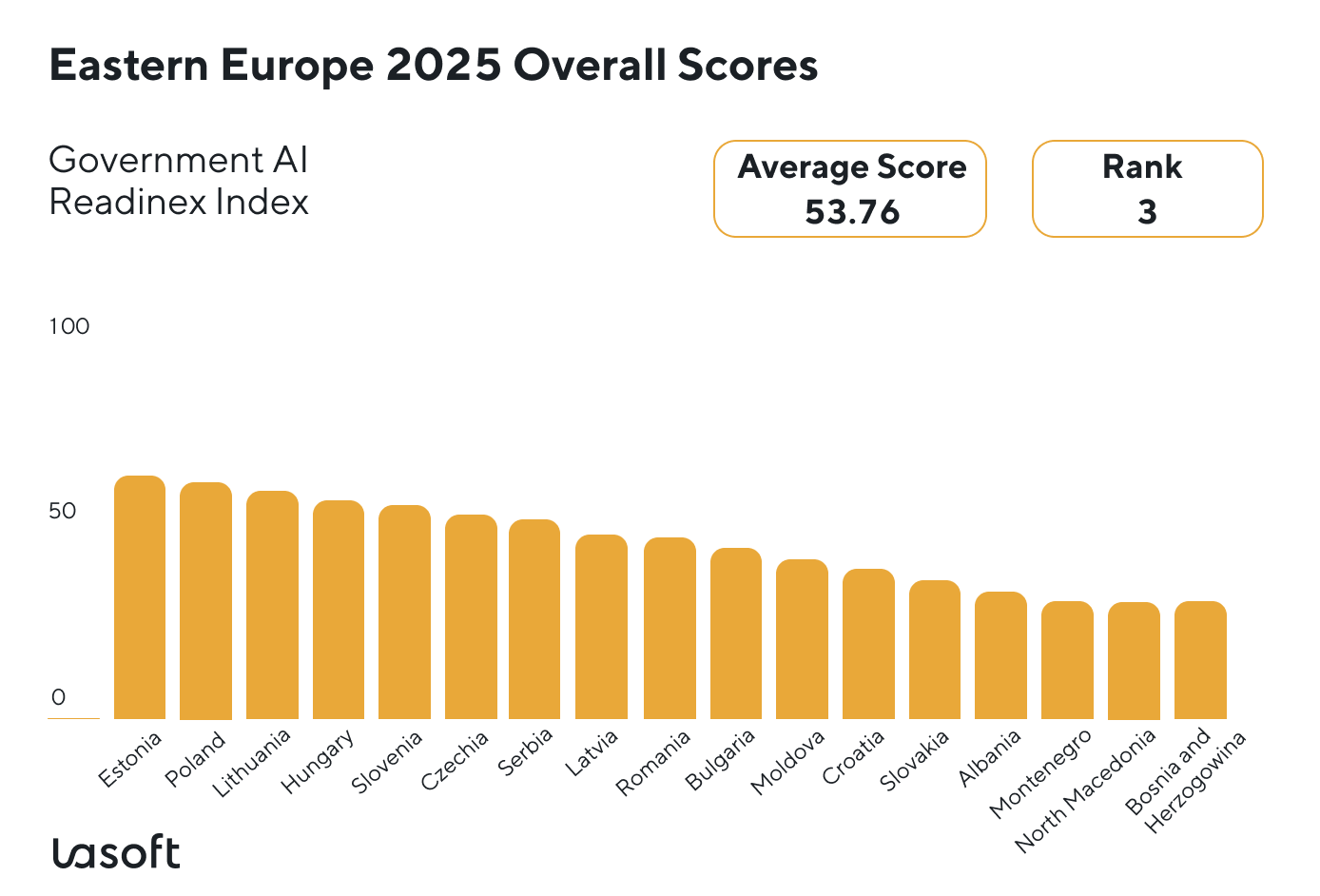
Source: Oxford Insights
Poland is the largest IT hub in Eastern Europe for outsourcing, staff augmentation, AI, and automation, supported by:
- strong engineering and academic talent pools,
- growing startup ecosystems in fintech, healthtech, and enterprise automation,
- the proximity to Western European clients seeking cost optimization and qualified expertise,
- competitive pricing relative to Western and the US markets,
- availability of English-speaking talent.
Compared with the U.S., salaries remain lower, but when adjusted for cost of living and labor productivity, Poland offers a highly competitive value proposition. The talent pipeline is fed by universities and boot camps that emphasize automation, as well as by the strong presence of software outsourcing companies in Poland. The n8n talent pool is growing from a small base to a few hundred professionals actively using it, and many more with adjacent skills (Zapier, RPA, etc.) can quickly learn n8n.
United States: The Global Hub of AI Adoption and Automation
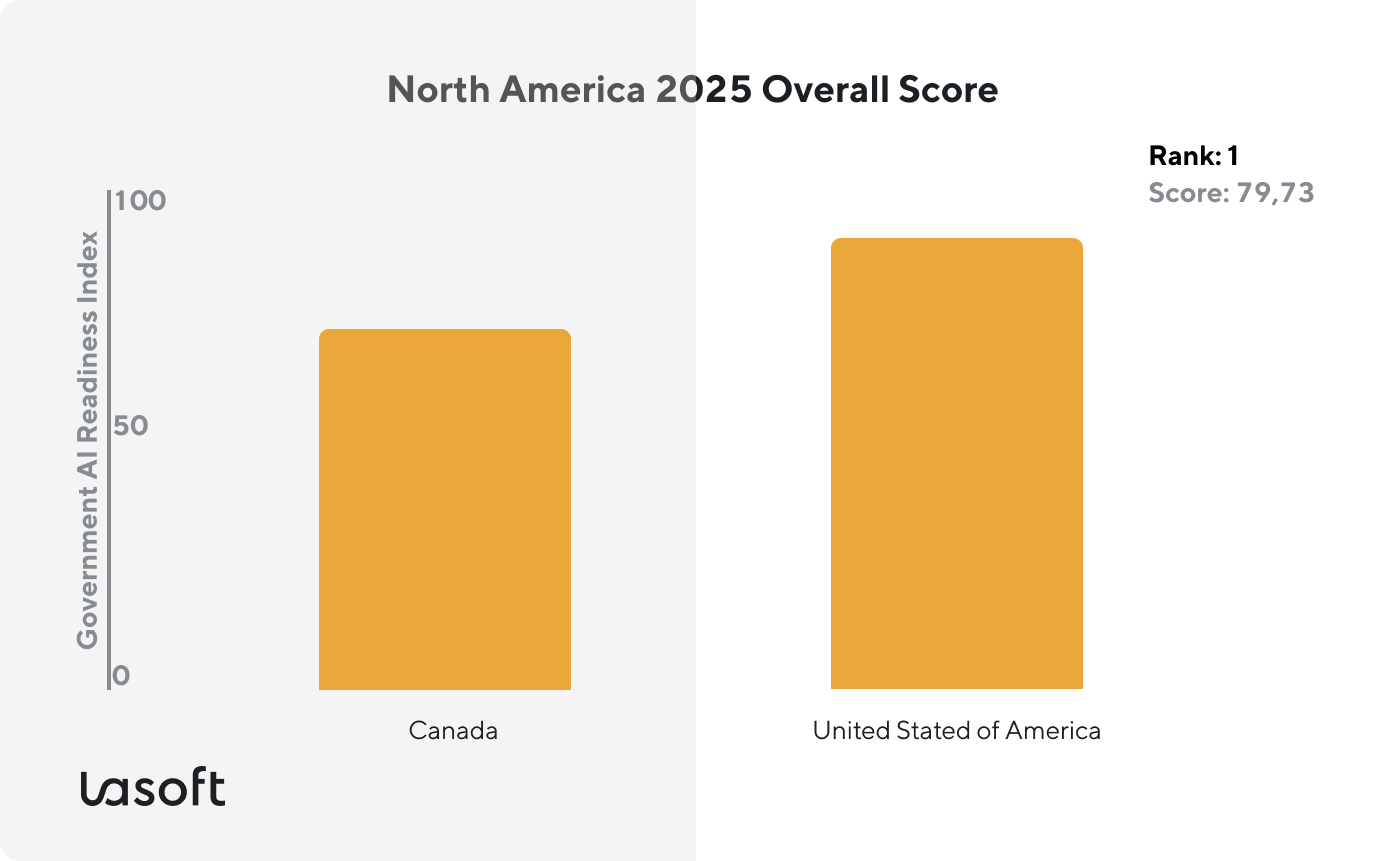
According to the Oxford Insights Government AI Readiness Index 2025, the United States is the most mature and dynamic AI market, ranking #1. It declares itself as a technological hub and a strategic driver for the next generation of AI-driven industries.
Thanks to the US and Canada, North America remains the highest-performing region in global AI readiness, with an average score of 79.75, outperforming Western Europe by 17 points. At the same time, the U.S. itself scores 87.20. This leadership is supported by Silicon Valley’s concentration of frontier AI labs, Big Tech ecosystems, and extensive venture capital networks. Furthermore, the U.S. government treats AI as both a technological and geopolitical priority, accelerating adoption across the defense sector, federal agencies, and the public sector.
This strategy directly influences labor markets by increasing demand for engineers skilled in integrating AI into business workflows, customer journeys, and internal systems.
Although the U.S. market is more advanced than Poland or Ukraine in AI product development, it also faces significant shortages of automation engineers proficient with low-code platforms such as n8n, Zapier, Make, Power Automate, and Workato, who can enhance workflows with JavaScript, Python, vector databases, and prompt engineering. These professionals are especially valuable in industries undergoing rapid digitization, including fintech, e-commerce, cybersecurity, healthcare, and logistics.
Looking ahead to 2026, several skills are in the highest demand for AI Automation Engineers in the U.S.:
- Enterprise AI adoption: The U.S. also leads in AI diffusion and in the extent to which businesses apply AI in production scenarios.
- AI Agents: U.S.-based companies are among the earliest adopters of AI assistants, copilots, and autonomous workflows.
- Operational cost optimization: Firms increasingly view automation as a smart way to optimize internal workflows and data flows.
- Venture capital incentives: AI startups receiving funding are pressured to deploy automation early to scale with fewer engineers.
- IT Consultants and outsourcing vendors: U.S. companies often rely on hybrid delivery models, engaging automation specialists in Poland, Ukraine, and LATAM as part of a cost-optimization strategy and to address talent shortages.
Automation Engineers’ Salaries (Poland vs United States vs Ukraine)
It’s obvious that the salary range for automation engineers, as well as any other IT position, differs depending on the country, and the US offers the highest rate in the job market. The figures we give are broad estimates. Actual pay depends on the employer, the candidate’s exact skill set, and the contract type. In Poland, many IT jobs are on B2B contracts with higher gross pay to offset taxes, whereas US salaries might include other benefits. Nonetheless, it’s clear that U.S. salaries for n8n/automation engineer jobs are roughly 2–3 times higher than Polish salaries for similar roles and many times higher than Ukrainian equivalents.
| Seniority Level | Poland
(€/year) Source: Itentio |
United States
(USD/year) Source: Indeed |
Ukraine
(USD/year) Source: DOU |
| Junior
(0-2 years) |
$12,000 – $30,000 | $80,000 – $90,000 | $12,000 – $18,000 |
| Mid-level
(4–7 years) |
$45,000 – $65,000 | $90,000 – $100,000 | $48,000 |
| Senior
(8+ years) |
up to $90,000 | $110,000 – $140,000+ | $54,000 – $78,000 |
AI Automation Engineers’ Skills Companies Expect
Companies hiring in 2026 are seeking professionals who can integrate process engineering, software integration, and AI adoption into a unified skill set. The standards for automation jobs have increased: today’s automation engineers need to understand how business processes function, IT architecture, how data flows through systems, and how to use large language models (LLMs) or predictive algorithms to improve those processes.
In most companies, these engineers juggle IT, data, and business operations, acting as both designers and implementers of internal automation systems. Their responsibilities have expanded to include:
- integrating AI APIs into workflows (OpenAI, Anthropic, Azure AI, etc.),
- connecting internal and external systems via APIs,
- handling complex business logic and long-running workflows,
- managing data transformations and structured JSON output,
- working with secure environments and compliance constraints,
- communication with non-technical stakeholders.
For companies, the value proposition is clear: instead of hiring separate backend engineers, integration developers, and AI engineers for internal tooling, one AI Automation Engineer can cover a significant part of the tasks, reducing operational overhead and accelerating delivery.
| Generative AI Integration | Building AI-powered assistants and copilots
Implementing RAG (retrieval-augmented generation) workflows Designing intelligent automation pipelines Creating conversational and task-oriented interfaces |
| Core Engineering Skills | Software development foundations (clean, maintainable code)
Machine learning concepts (models, evaluation, optimization) DevOps / MLOps |
| Systems Architecture and Design | Designing systems that scale and tolerate failures
Managing speed, cost, and accuracy Debugging complex distributed systems and workflows |
| Workflow Automation Tools | Deep experience with n8n for workflows
Working with Webhooks, REST APIs, and data formats (JSON, CSV) Integrating AI APIs (OpenAI, Claude, etc.) and business tools Combining no-code elements with custom logic when needed |
| Programming Languages,
Control and Data Acquisition |
JavaScript (Node.js) or Python for building custom nodes and logic
Working with SQL/NoSQL databases Containerization using Docker for deployment scenarios |
n8n in AI-Driven Business Process Automation
To make business workflows seamless, companies seek software that can retrieve data from CRMs or ERPs, process documents with OCR or classification models, include human checks, and then send the results back to their internal systems. As you can see, modern businesses require more than just LLM responses; n8n’s orchestration feature has gained significant popularity due to its unique advantages over other workflow automation platforms:
- Open Source and Self-Hosting: Unlike Zapier or Make (formerly Integromat), n8n is open-source and can be self-hosted. This gives companies full control over their data and workflows, providing data privacy and compliance (GDPR, etc.)
- Licensing and Cost: Companies can start with the Community Edition at no cost, then upgrade to paid plans for advanced features or support. N8n’s pricing model is predictable, especially the cloud version, which charges per workflow execution, not complexity. Overall, the potential for cost savings (or even zero software cost if self-hosting) makes n8n popular with startups and mid-size companies with tight budgets.
- Unlimited Workflow Complexity: N8n imposes no artificial limits on workflow complexity or branching in its self-hosted form. You can have long-running workflows, complex logic with loops/conditions, and hundreds of nodes if needed.
- Native Coding Option: N8n allows custom coding in workflows (via function nodes, etc.), enabling developers to write JavaScript or Python to handle logic beyond pre-built integrations. This blend of low-code and coding appeals to teams with some programming skills who want to easily expand workflows.
- Custom Nodes: There are over 400 pre-built integrations officially maintained, but if something is missing, you can create a custom node package.
- License and Vendor Independence: Many companies worry about vendor lock-in with SaaS tools and a vendor’s cloud. N8n’s model prevents getting stuck if the vendor changes terms or if you want to migrate. This aligns with a fair-code license philosophy: users can run the core for free and only pay for premium features.
Final Recap
Our market review indicates that the demand for talent is increasing across Poland, Ukraine, and the United States.
- The U.S. leads in AI adoption and offers the highest salaries, searching for skilled experts.
- Poland offers a competitive delivery hub for Western firms thanks to its high engineering density and nearshore location.
- Ukraine remains one of the fastest-growing AI labor markets, with strong supply and international outsourcing demand despite regional challenges.
FAQ
Why is an AI Automation Engineer Career in-demand?
What Industries Is AI Expanding Into?
- finance and banking,
- cybersecurity,
- e-commerce,
- logistics,
- retail,
- healthcare,
- manufacturing processes,
- call centers.
What is the proven ROI and cost-efficiency of automation engineering?
- customer service automation reduces average handle time,
- document AI reduces manual data entry,
- AI copilots reduce administrative overhead,
- workflow automation reduces backend engineering cost,
- and AI-assisted decision-making accelerates approvals.